Disclosure: This post contains affiliate links. If you buy through our links, we earn a small commission at no extra cost to you. Read our affiliate policy.
The dishwasher market in India has exploded in the last 3 years. But here's the uncomfortable truth: most dishwasher reviews online are written for Western kitchens. They don't address the specific challenges of Indian cooking — the oily curries, the charred tavas, the stubborn Haldi stains, and the uniquely Indian vessels we use.
This guide is written specifically for Indian households. Let's dig in.
Step 1: What is a "Place Setting" and How Many Do You Need?
Every dishwasher is rated by its capacity in "place settings." One place setting represents the dishes used by one person for one complete meal — typically:
- 1 dinner plate
- 1 side plate / salad plate
- 1 bowl (for dal or sabzi)
- 1 glass
- 1 cup and saucer
- 1 fork, knife, and spoon set
So if you have a family of 4, and you want to wash everything from one meal in one cycle, you technically need a 4-place setting dishwasher minimum.
However, we recommend buying at least double your family size in capacity, for a few reasons:
- Serving bowls, kadhai, and cooking vessels also go in the dishwasher.
- You'll likely not run the machine after every single meal — you'll load it throughout the day and run it once at night.
- Indian cooking generates significantly more utensils per meal than a typical Western meal.
Our Recommendation:
| Family Size | Recommended Capacity |
|---|---|
| 1-2 people | 6-8 place settings |
| 3-4 people | 10-13 place settings |
| 5+ people | 13-15 place settings |
Step 2: Can Indian Vessels Actually Fit Inside a Dishwasher?
This is the most common concern from Indian buyers, and the answer is yes — with the right loading strategy.
What goes in without any issues:
- Dinner plates, bowls, glasses
- Stainless steel dabbas, tiffin boxes
- Small to medium Kadhais (if they have a flat bottom)
- Pressure cooker vessels (not the lid with the gasket)
- Baking trays, baking molds
What needs care:
- Large Kadhai / Wok: A large Kadhai (30 cm+) can be tricky to fit. Check the brand's loading diagram: Bosch's 13-place SMS66GW01I, for example, shows a kadhai, a 5 L cooker and two tawas in the lower rack.
- Pressure Cooker Lid: The rubber gasket should be removed and hand-washed, as the dishwasher heat degrades rubber over time.
- Non-stick coated vessels: Dishwasher heat and detergent wear most non-stick coatings faster; hand-wash them unless the pan says it is dishwasher-safe.
- Haldi (Turmeric) stains: This is genuinely tricky. A standard dishwasher cycle may not fully remove deep Haldi staining from plastic containers. A hot program (Bosch's Intensive Kadhai at 70°C, or IFB's Hygiene at 70°C) is your best bet.
What should NOT go in:
- Copper and brass vessels (will discolor)
- Wooden items (ladles, chopping boards — they will warp and crack)
- Crystal glassware (may etch)
- Cast iron tawa or skillet (will rust)
Step 3: Choosing the Right Wash Program for Indian Food
Oil and spice are the defining features of Indian cooking, and a standard "Normal" wash cycle is not aggressive enough for a Biryani pot or a Kadhai with dried curry residue.
Here are the programs you should look for:
Intensive / Heavy Duty (60°C-70°C): This is your workhorse for Indian cooking. The high temperature dissolves oil and spice residue far more effectively than a cold wash. Every premium dishwasher has this, but it uses more electricity and water. Reserve it for heavily soiled vessels.
Auto / Sensor Wash: The dishwasher uses sensors to detect how dirty the water is, and automatically adjusts the temperature and cycle time. This is a great "set and forget" option for daily mixed loads.
Quick Wash (35-45 minutes): Ideal for lightly used vessels, glasses, and plates that are rinsed before loading. Not suitable for oily or heavily soiled cookware.
Eco Wash (at lower temperatures): Very efficient on electricity and water, but not effective enough for the oily residues of Indian cooking. Use this only for glasses and lightly soiled items.
Step 4: The Most Important Feature — A Water Softener
This is the feature many buyers overlook, and it's critical in India.
Hard water (found in most Indian cities including Delhi, Bangalore, Pune, and Hyderabad) contains dissolved calcium and magnesium. When hard water is used in a dishwasher without softening, these minerals dry on your dishes as a white, chalky film. Your "cleaned" dishes come out looking dirty.
Every good dishwasher has a built-in water softener, but it requires you to regularly add dishwasher salt (also called regeneration salt) to a dedicated compartment at the bottom of the machine. This is different from dishwasher detergent. Do not skip this step if you have hard water.
Check your water with a TDS meter (a few hundred rupees online) and set the softener's hardness level to match. See our hard water guide.
Step 5: Which Brand Should You Choose?
We only list dishwashers rated 4.0★ or higher on Amazon, with at least 100 reviews and at least 50 bought in the past month. Right now that is six models from three brands:
Bosch — Three models, including the best seller. The SMS66GW01I (13 place, 44 dB, about ₹45,500) is our Best Overall; the SMS46KI03I adds 15 place settings and a cutlery drawer.
IFB — The highest-rated and cheapest model, the Neptune FX14 (4.4★, about ₹42,800), plus the 15 place Neptune VX15. Both are louder than the Bosch, at 52 dB.
LG — The DFB424FP is the only one we list with a steam wash and Wi-Fi, and it has a 10-year motor warranty.
Other brands, including Faber, Midea, Hafele and Electrolux, sell dishwashers in India, but none of their models currently meets that bar.
Summary: Our Quick-Reference Buying Checklist
Before you buy, run through this checklist:
- Capacity: Have you chosen at least double your family size in place settings?
- Water Softener: Does it have a built-in salt compartment for hard water?
- Intensive Mode: Does it have a 70°C or "Intensive" heavy-duty cycle?
- Service Network: Does the brand have authorized service centers in your city?
- Adjustable Racks: Can the upper rack be lowered to fit large Indian pots?
- Ratings and sales: Is it rated 4★ or higher, with a solid number of reviews and recent sales?
See our top-rated Dishwashers in India →
Related Articles
- IFB vs Bosch Dishwasher India 2026
- Dishwasher and Hard Water in India: Complete Guide
- Dishwasher vs Maid — Cost Comparison India
- How to Clean a Dishwasher in India
Frequently Asked Questions
How many place settings do I need for an Indian family?
For a family of 2–3: a 6–8 place setting compact or countertop model is enough, though none currently meets our bar, so the smallest we list is 13 place. For a family of 4–5: a 12–14 place setting dishwasher is ideal. For a joint family of 6+: a 15 place setting dishwasher is recommended. One "place setting" includes a dinner plate, side plate, soup bowl, glass, and cutlery for one person.
Can a dishwasher clean Indian oily cooking — kadhai, pressure cooker, tawa?
Yes, with the right programme. Use a hot programme for Indian cookware: Bosch's Intensive Kadhai (70°C), IFB's Pots & Pans (65°C) or Hygiene (70°C), or LG's Intensive. This high-temperature wash effectively removes cooking oil, dried masala, and dal residue. Always scrape off large food pieces before loading. Non-stick pans and non-induction aluminium pressure cookers should be hand-washed as the dishwasher can damage their coatings.
What is the minimum water pressure needed for a dishwasher in India?
It varies by model; the LG DFB424FP, for example, lists 0.05–1.0 MPa (0.5–10 bar). Homes fed from an overhead tank on the floor above can have very low pressure, so check the model's minimum pressure in its manual before buying, or ask the brand at installation.
Should I buy a built-in or freestanding dishwasher for an Indian kitchen?
For most Indian households, a freestanding dishwasher is the better choice. It does not require kitchen renovation, can be moved if you change homes, and usually costs less than a built-in model. Built-in dishwashers are ideal if you are doing a full modular kitchen renovation and want a seamless look.
Does a dishwasher need a dedicated water connection?
Yes. A dishwasher needs a dedicated cold water inlet connection (typically a ½-inch connector) and a drain connection. Most Indian installations connect to the kitchen sink's water inlet and drain pipes. Ask the brand whether installation is free or charged when you book it.
Which dishwasher brands have the best service network in India?
Bosch, IFB and LG, the three brands we list, all have national service networks, but coverage varies by town. Check the brand's service locator for your pin code before buying, especially outside the big cities.
Related Reading
- Best Dishwasher in India 2026 — Expert-ranked picks for Indian kitchens
- Dishwasher vs Maid — Cost Comparison India — Is it worth it?
- IFB vs Bosch Dishwasher India — Top brands compared
Our Top Picks — Based on Your Kitchen Size
Best Overall (13 Place Settings)
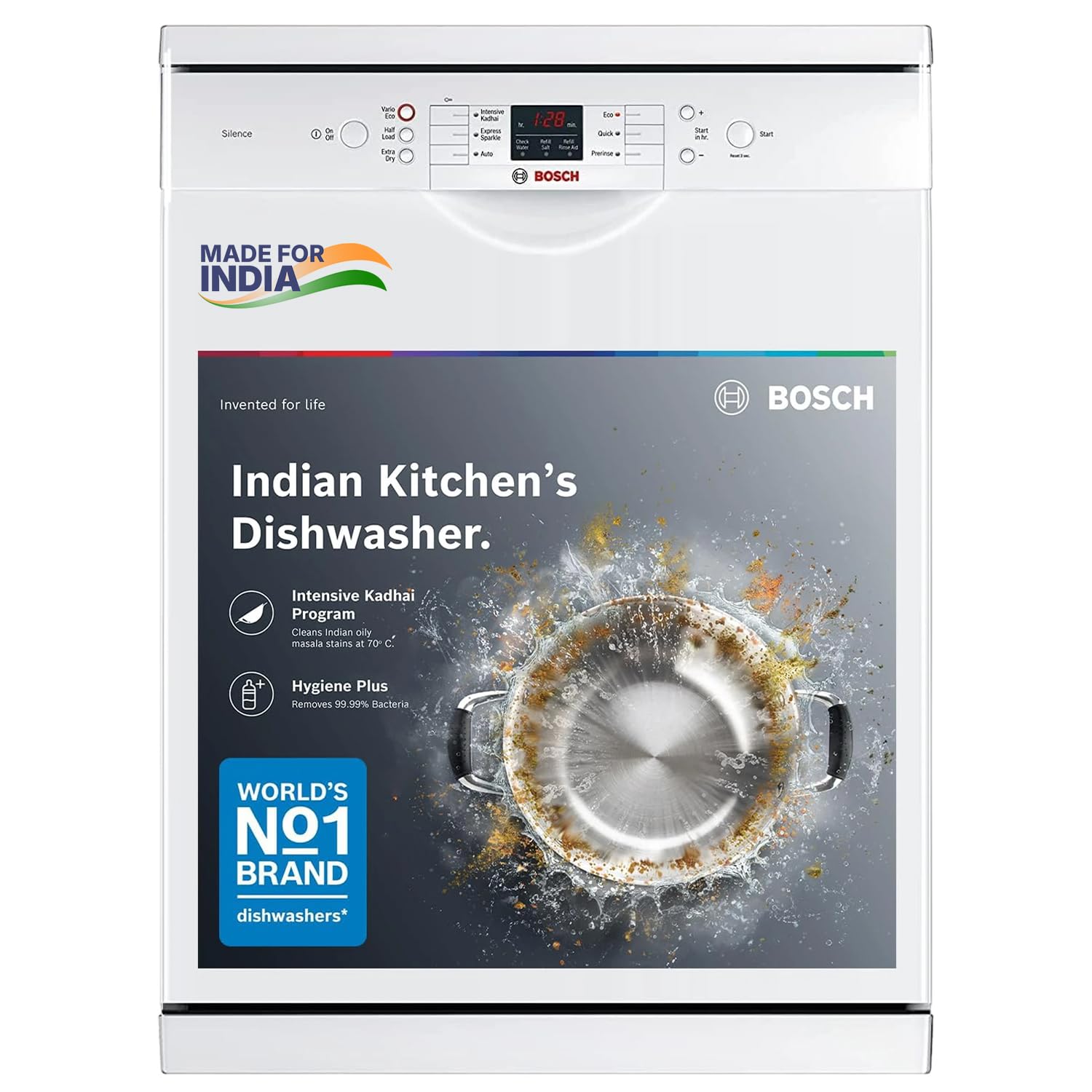
Bosch 13 Place Free-Standing Dishwasher, Intensive Kadhai Program (SMS66GW01I, White)
Families of 4-6 wanting the best-selling, well-proven dishwasher
Best for Large Families (15 Place Settings)
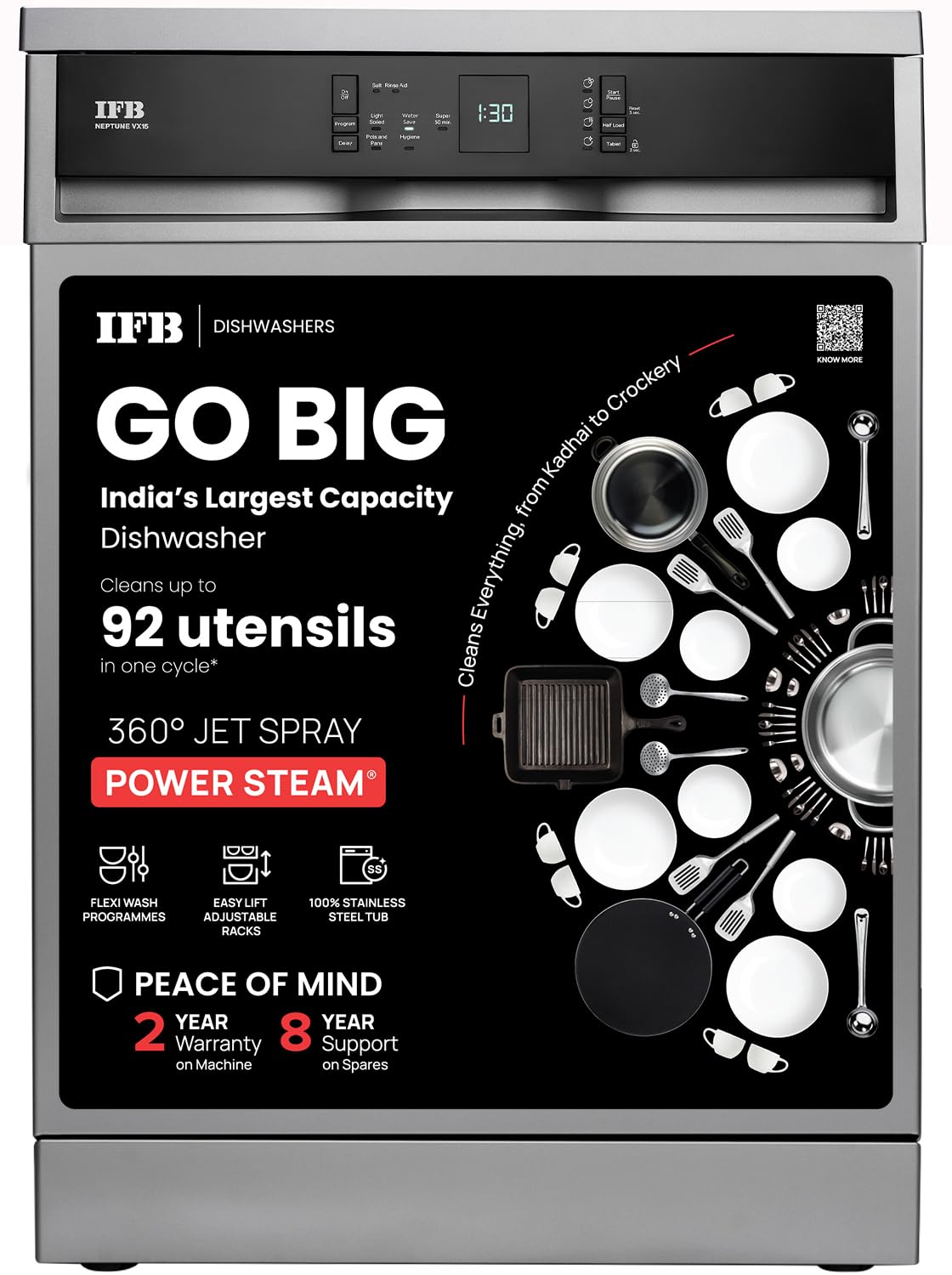
IFB Neptune VX15 15 Place Dishwasher with 3rd Cutlery Tray
Large families wanting 15 place settings and a cutlery tray for less than the 15 place Bosch
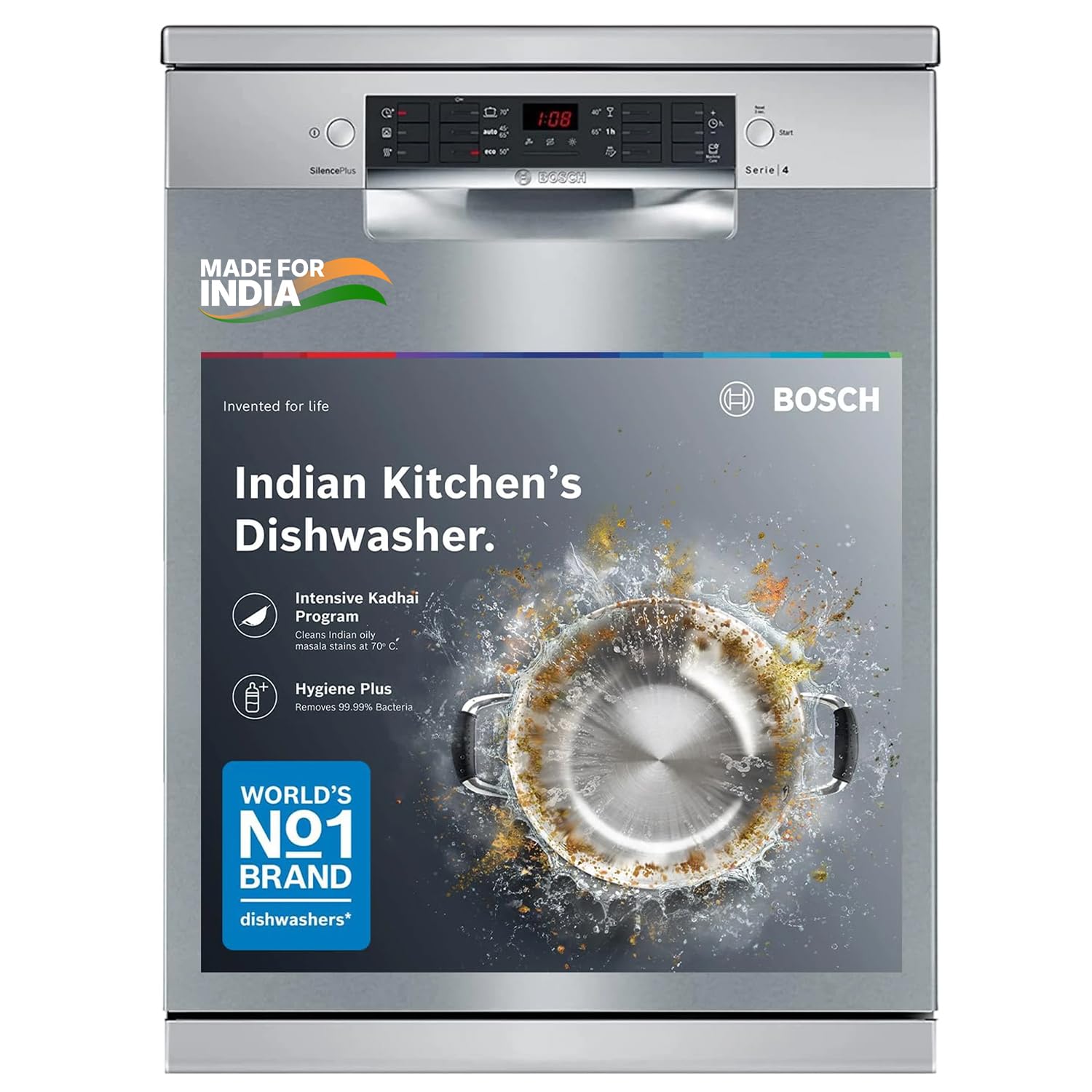
Bosch 15 Place Free-Standing Dishwasher with Cutlery Drawer (SMS46KI03I, Silver Inox)
Large and joint families who need 15 place settings and a cutlery drawer
See the full dishwasher rankings → Best Dishwasher in India 2026