Disclosure: This post contains affiliate links. If you buy through our links, we earn a small commission at no extra cost to you. Read our affiliate policy.
A few months after buying a dishwasher, many Indian owners notice a white haze on glasses, chalky deposits inside the machine and dishes that feel gritty. That is rarely a faulty machine. It is hard water, and it is the most common reason dishwashers disappoint in India.
This guide covers why Indian water is so hard, what it does to a dishwasher, how to protect your machine, and which dishwashers handle it best.
Quick Answer
Do dishwashers work well with hard water in India?
Yes, if the built-in water softener is used properly. All six dishwashers we list have one, and it only works when you keep it filled with dishwasher salt and set it to your water's hardness. The Bosch SMS46KI03I is the only one whose listing states a limit, up to 880 ppm, so it is the safest choice for very hard water.
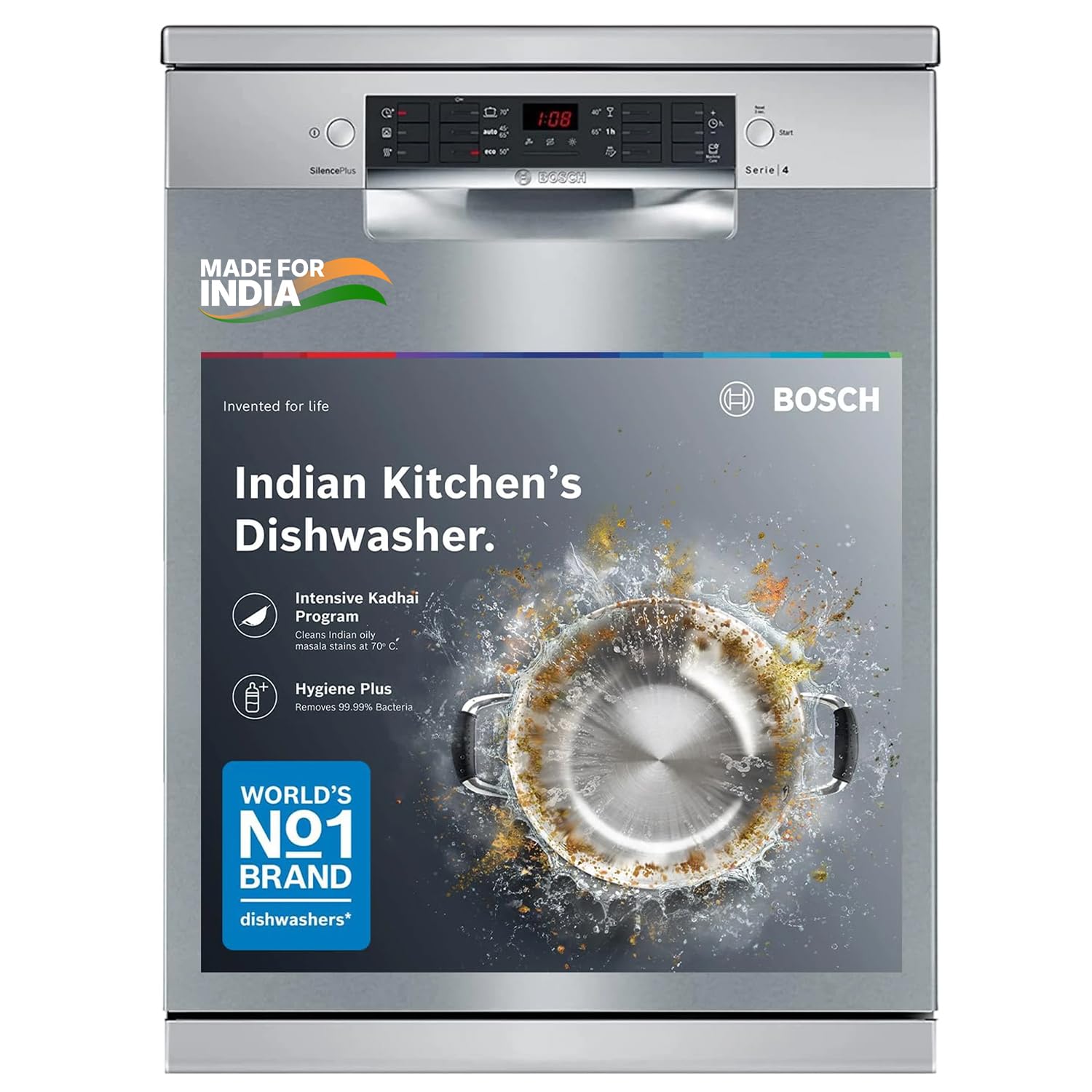
OUR TOP PICKBosch 15 Place Free-Standing Dishwasher with Cutlery Drawer (SMS46KI03I, Silver Inox)
Large and joint families who need 15 place settings and a cutlery drawer
4 (616)₹58,990₹68,99014% off
Understanding India's Hard Water Problem
"Hard water" has a high concentration of dissolved calcium and magnesium. At home, most people measure it with a TDS (total dissolved solids) meter, in mg/L or ppm. TDS counts all dissolved solids, not only hardness, but it is a useful rough guide.
India's drinking-water standard (BIS IS 10500) puts the acceptable limit for total hardness at 200 mg/L and the permissible limit at 600 mg/L. Many Indian homes, especially on borewell water, are well above the acceptable limit.
Rough TDS Ranges in Major Indian Cities
| City | Rough TDS range (mg/L) |
|---|---|
| Delhi (municipal supply) | 400–600 |
| Gurugram / Faridabad | 500–800 |
| Jaipur | 600–900 |
| Bangalore (municipal supply) | 200–350 |
| Mumbai (municipal supply) | 100–180 |
| Hyderabad | 300–500 |
| Chennai | 250–450 |
| Pune | 200–350 |
| Ahmedabad | 400–700 |
Important: readings vary a lot by locality, season and source. Borewell water is usually much harder than municipal supply. Test your own tap with a TDS meter before setting up the machine.
How Hard Water Damages Your Dishwasher
Hard water leaves limescale, calcium and magnesium deposits, on every surface it touches.
1. Spray Arm Clogging
Spray arms have small holes that jet water at the dishes. Scale narrows and eventually blocks them, so the wash gets weaker and dishes come out dirty.
2. Heating Element Scale
Scale on the heating element insulates it, so it works harder to reach wash temperature and can fail sooner.
3. White Residue on Dishes
A white haze or chalky film on dishes and glasses is usually limescale. It comes off with a vinegar rinse and goes away once the softener is set up properly. (Permanent cloudiness, called etching, is a different problem, usually from soft water and too much detergent.)
4. Weaker Detergent
Hard-water minerals react with detergent and reduce its cleaning power, so owners end up using more detergent for the same result.
What Is Dishwasher Salt and Why Do You Need It?
Dishwasher salt is coarse, pure sodium chloride, not cooking salt. Every dishwasher we list has a built-in softener: a resin that swaps the calcium and magnesium in incoming water for sodium. The resin fills up with minerals, and the salt recharges it. Without salt, hard water goes straight into the wash.
How to Check and Top Up Dishwasher Salt
- Most dishwashers have a salt indicator light; top up when it comes on.
- The salt reservoir is at the bottom of the tub, under a screw cap.
- Use only dedicated dishwasher salt. Cooking, table or rock salt contains additives and impurities that can damage the softener.
- Fill the reservoir with a funnel, and wipe up any spilled salt before running a cycle.
Setting the Water Hardness Level
This step is often skipped. The softener has an adjustable hardness setting; set it from a TDS or hardness test of your water, using the table in your machine's manual. Set too low, the softener doesn't recharge often enough and hard water gets through. A higher setting uses more salt but protects the machine and dishes.
Rinse Aid: The Second Line of Defence
Rinse aid makes water sheet off dishes instead of forming droplets, and droplets are what leave white spots when they dry. With rinse aid, drying is faster and glassware comes out clear. In hard water, keep both salt and rinse aid topped up.
Which Dishwashers Handle Indian Hard Water Best?
All six dishwashers we list have a built-in softener. Every one is rated 4.0★ or higher on Amazon, with at least 100 reviews and at least 50 bought in the past month.
1. Bosch SMS46KI03I — Best for Very Hard Water
The only one whose listing states a softener limit: up to 880 ppm. It is also a 15 place machine with a cutlery drawer and an Intensive Kadhai program at 70°C. 4.0★ from 616, about ₹60,000.
2. Bosch SMS66GW01I — Best Overall
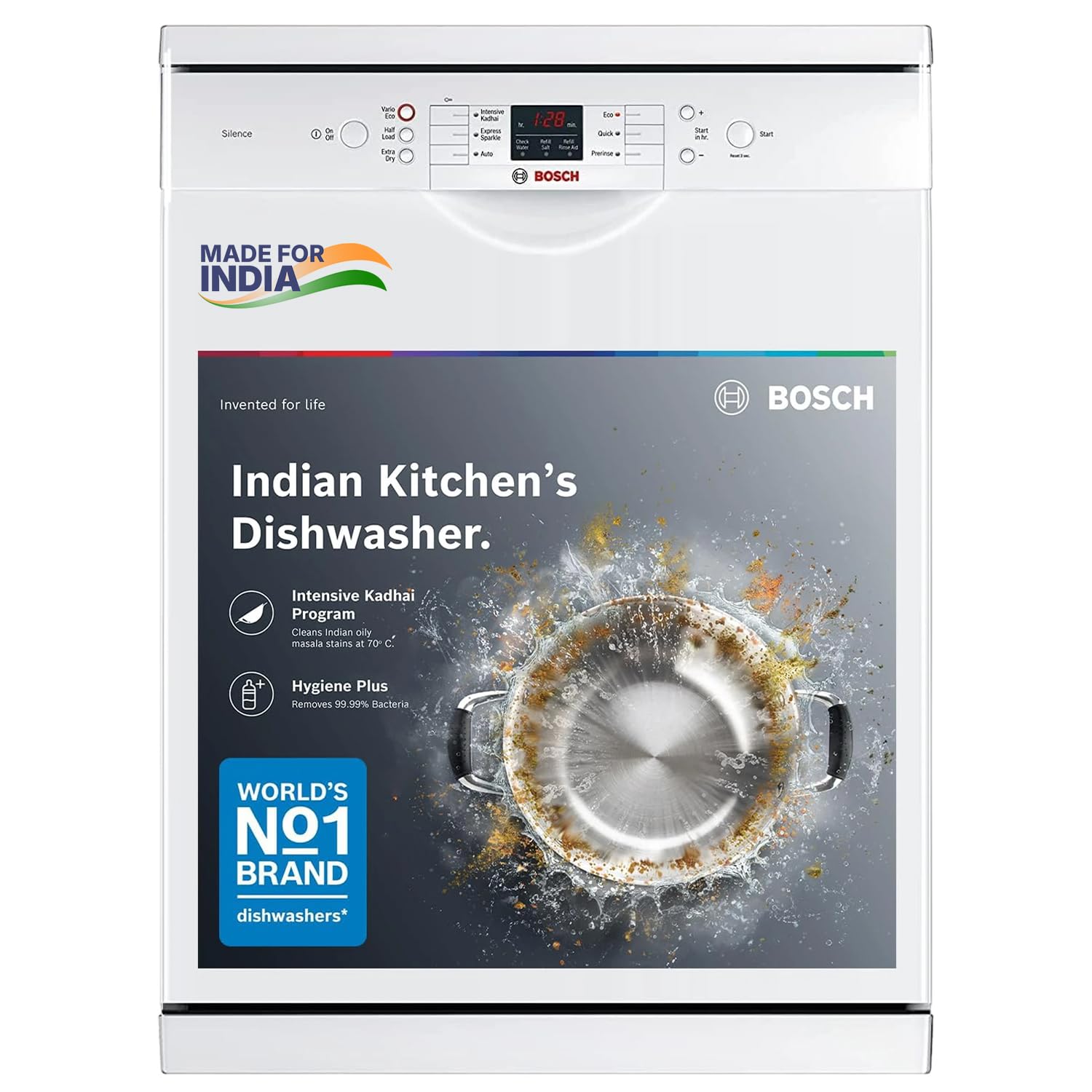
The best-selling dishwasher we list (300+ a month, 4.2★ from 2,305). Its listing names a hard water softener, with load and aqua sensors, 9.5 L a cycle and 44 dB. The SMS66GI01I is the same machine in Silver Inox.
Bosch 13 Place Free-Standing Dishwasher, Intensive Kadhai Program (SMS66GW01I, White)
Families of 4-6 wanting the best-selling, well-proven dishwasher
3. IFB Neptune FX14 and Neptune VX15
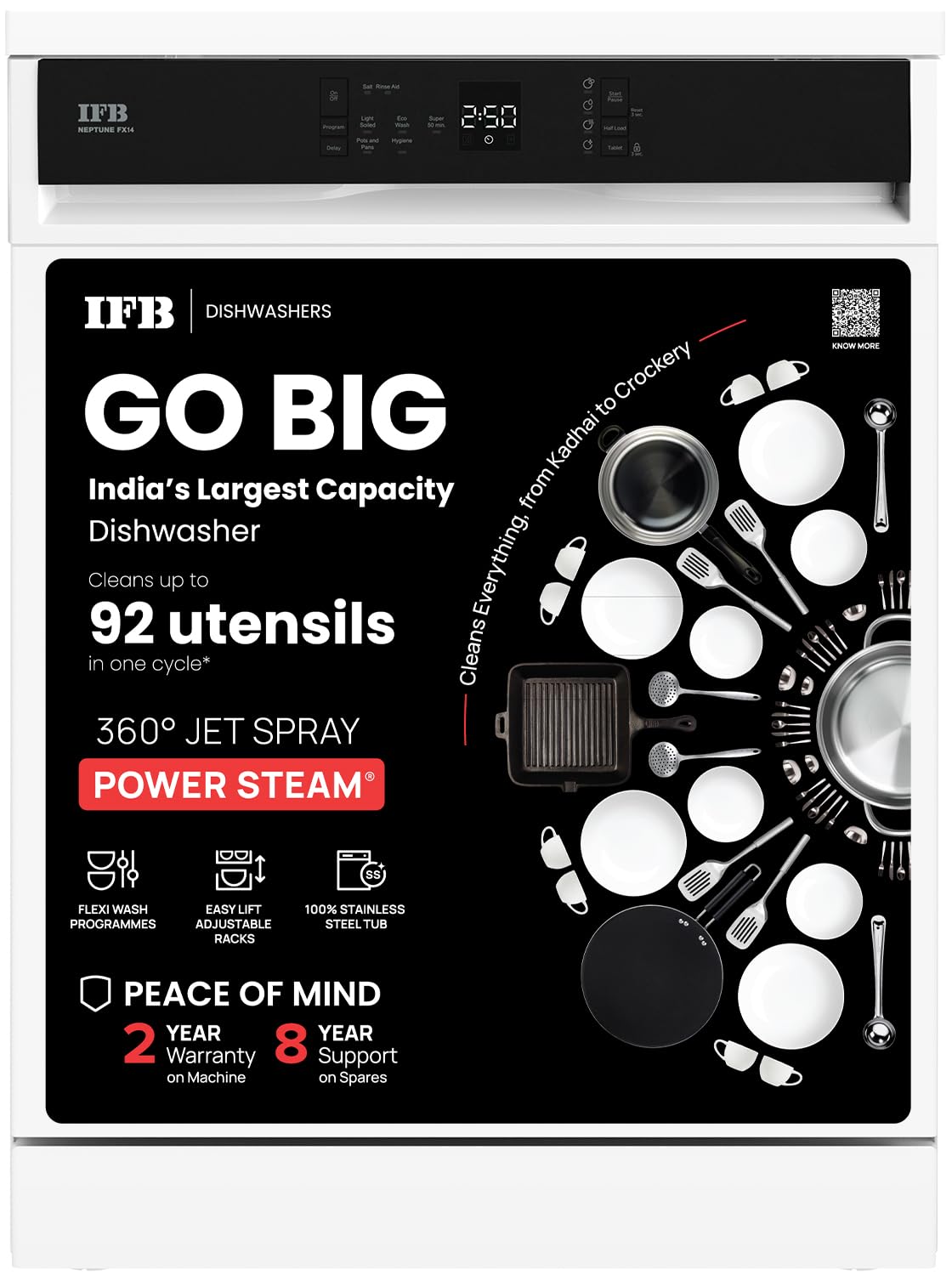
Both IFB listings name an in-built water softening device, and both have 70°C Hygiene and 65°C Pots & Pans programs. The FX14 is the highest-rated dishwasher we list (4.4★) and the cheapest; the VX15 has 15 place settings.
IFB Neptune FX14 14 Place Dishwasher with 70°C Hot Water Wash
Families of 4-6 wanting the highest-rated dishwasher at the lowest price
4. LG DFB424FP
The LG ships with a salt refill funnel and has a salt indicator on its panel, so it softens water the same way.
Practical Maintenance Routine in Hard Water Areas
Weekly
- Check the rinse aid level and top up as needed
- Look at glasses after a cycle: white spots are an early warning that the salt or hardness setting needs attention
Monthly
- Clean the filter at the bottom of the tub under a tap
- Check the spray arm holes and clear any blocked ones with a toothpick
- Run a dishwasher cleaner or descaler through an empty hot cycle (monthly in very hard water, every two months otherwise)
Every 3 Months
- Wipe the door seals with a damp cloth
- Recheck the hardness setting if your water source has changed
Should You Buy a Dishwasher If You Have Very Hard Water?
Yes, with some care. If your water is very hard (common in parts of Delhi NCR, Rajasthan, Gujarat and borewell areas):
- Choose a model whose softener suits your water. The Bosch SMS46KI03I states a limit of 880 ppm; for the others, ask the brand for the maximum hardness.
- Set the hardness level correctly in the machine's settings.
- Never let the salt run out.
- Use rinse aid, even with all-in-one tablets.
- Consider an inlet softener if your water is extremely hard, to protect the dishwasher and your plumbing.
Frequently Asked Questions
Q1. How do I know if my water is hard?
Use a TDS meter (a few hundred rupees online). As a rough guide, readings above about 300 mg/L suggest hard water and above 600 very hard. White deposits on taps, or fast scale build-up in your geyser, are other signs.
Q2. Can I use regular table salt instead of dishwasher salt?
No. Table salt contains anti-caking agents and other additives that can damage the softener. Use dedicated dishwasher salt; it is coarser and purer.
Q3. Why do my glasses look cloudy even after a dishwasher wash?
In hard water it is almost always limescale, which comes off with a vinegar rinse. Check that the salt is topped up, the hardness setting is high enough and the rinse aid isn't empty.
Q4. How much dishwasher salt will I use?
It depends on your water's hardness, the hardness setting and how often you run the machine. Harder water and a higher setting use more. Refill whenever the salt light comes on.
Q5. Is Bosch or IFB better for hard water?
Both have built-in softeners. The Bosch SMS46KI03I is the only model we list with a stated limit (880 ppm), so for very hard water it is the safest pick. For moderately hard water, any of the six works if the salt and hardness setting are looked after.
Q6. Do I need a separate water softener?
Usually not, because the dishwasher has one built in. If your water is extremely hard, an inlet or whole-house softener protects both the dishwasher and your plumbing.
Q7. How often should I run a dishwasher cleaner cycle?
Monthly in very hard water, every two months in moderately hard water. Use a dishwasher cleaner; a cup of white vinegar in an empty hot cycle also works as a mild descaler.
Related Reading
- Best Dishwasher in India 2026 — All models ranked
- IFB vs Bosch Dishwasher India — Top brands compared
- How to Choose a Dishwasher for an Indian Kitchen — Complete buying guide
- How to Clean a Dishwasher in India — Filters, spray arms and descaling