Disclosure: This post contains affiliate links. If you buy through our links, we earn a small commission at no extra cost to you. Read our affiliate policy.
"How much will it add to my electricity bill?" — this is the second question Indian buyers ask after price. It is also one of the most wildly misunderstood. Some people expect a dishwasher to consume as much as an air conditioner. Others assume it is negligible. Here's a grounded estimate based on typical energy-label consumption figures for this appliance class, plus the one published figure we have for a model we list.
A note on methodology: We don't have a calibrated energy meter running a multi-machine 30-day test — what follows is based on typical BEE-label consumption ranges for dishwashers in this class, plus the annual consumption published on one listing we track. Treat the ranges as reasonable estimates, not lab measurements.
Quick Answer
How much electricity does a dishwasher use per month in India?
A dishwasher running one cycle per day in India typically consumes roughly 20–45 units (kWh) per month, depending on the model, program, and how many cycles you actually run. At ₹6–₹8 per unit, that's roughly ₹150–₹350 per month. Using Eco mode instead of Normal or Intensive meaningfully reduces this. For one real data point: the Bosch SMS66GW01I (A+++) is rated at 292 kWh a year, about 1 kWh a cycle, or roughly ₹210–₹240 a month at one cycle a day.
Understanding Dishwasher Power Consumption: The Numbers
A dishwasher's electricity consumption depends on three things:
- The heating element — heats water to the target wash temperature (most of the energy)
- The circulation pump — circulates water through the spray arms (minimal energy)
- The drain pump and control electronics — negligible
The rated wattage on a dishwasher's specifications label (typically 1,200W–2,100W) is the peak draw — the maximum the heating element pulls at full intensity. The actual energy consumed per cycle is far lower than this figure suggests, because the heating element is not running continuously throughout the entire cycle.
Actual vs rated consumption:
- Rated: 1,600W × 1.5 hours = 2.4 kWh (if the element ran continuously at full power)
- Actual: typically well under this, since the heating element cycles on and off as needed rather than running the whole time
This is why the rated wattage is misleading as a consumption indicator. Use the BEE star rating (or, for European-badged models sold in India, the A+++/A++ energy class) and the per-cycle consumption figure from the official energy label instead of estimating from peak wattage.
How Long Is a Dishwasher Cycle? Time vs Energy
Cycle length and energy consumption have a complex relationship in modern dishwashers:
| Program | Typical Duration | Why |
|---|---|---|
| Quick / Fast (45°C) | 30–45 min | Short, lower temp — less energy but less effective on heavy soiling |
| Normal (60°C) | 90–120 min | Standard daily use — energy used for heating, not just time |
| Intensive (70°C) | 120–150 min | Heats to higher temp — most energy per cycle |
| Eco (50°C) | 150–200 min | Longer time, lower temperature — most energy-efficient overall |
| Auto / Smart | 60–120 min | Machine decides based on soil level via sensors |
The counterintuitive truth about Eco mode: The Eco program generally uses less electricity despite running the longest. Lower temperature means less energy for heating, and the extended cycle time compensates with longer physical wash exposure rather than more heat. As a rough rule of thumb, Eco mode typically uses noticeably less electricity than Normal mode — check your specific model's energy label for its exact figures.
What We Actually Know: One Published Figure
Rather than presenting invented per-machine lab data, here's the one dishwasher we list whose Amazon listing gives an annual consumption figure:
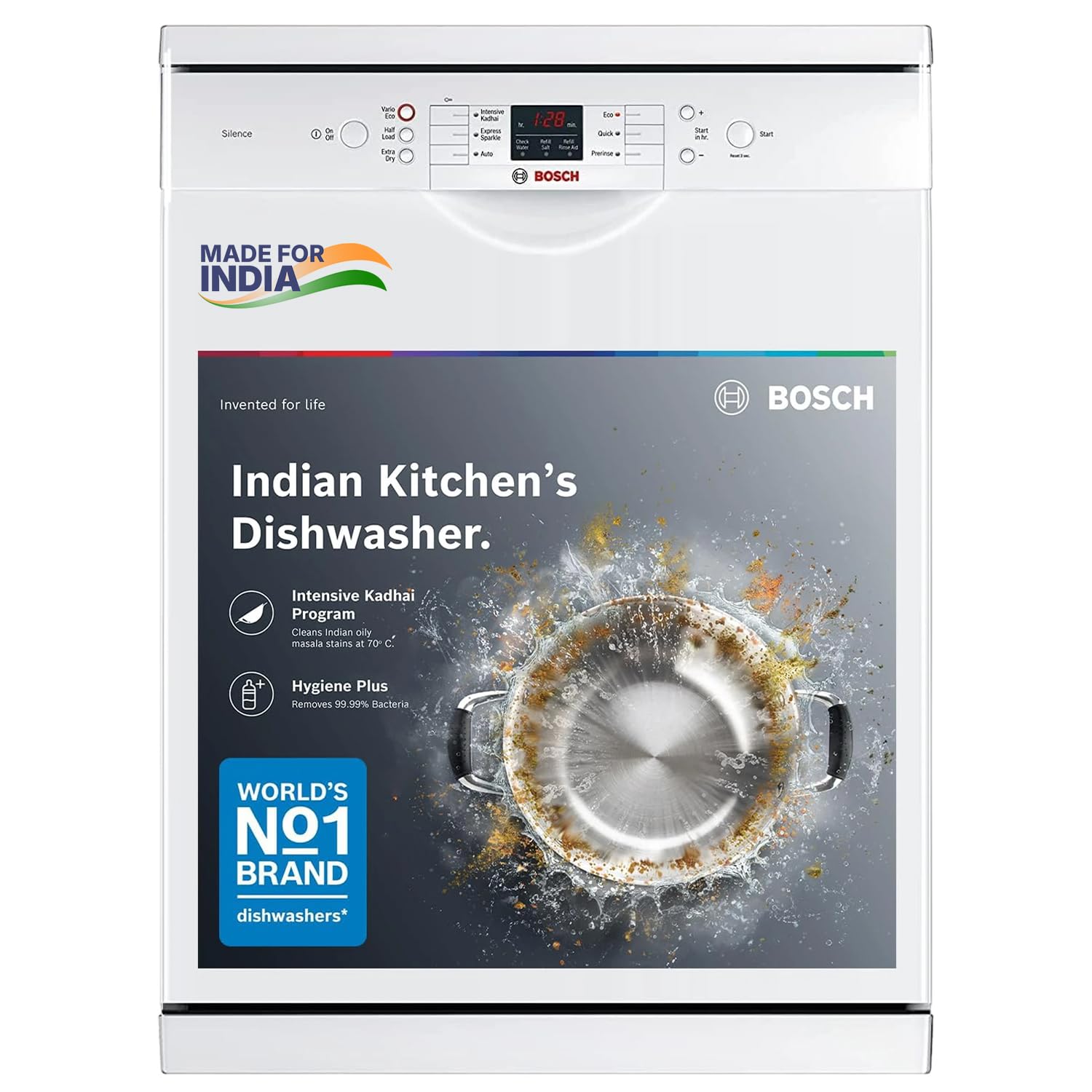
Bosch 13 Place Free-Standing Dishwasher, Intensive Kadhai Program (SMS66GW01I, White)
Families of 4-6 wanting the best-selling, well-proven dishwasher
- Rated consumption: 292 kWh a year (the EU label assumes 280 standard cycles a year), about 1 kWh a cycle
- Estimated monthly cost (30 cycles at ₹7–8 a unit): about ₹210–₹240
- Energy class: A+++ (the top European energy class)
The Bosch SMS66GI01I is the same machine in Silver Inox, and the 15 place SMS46KI03I is also rated A+++. Both IFB models we list, the Neptune FX14 and VX15, are rated A++, one class below; the LG DFB424FP's listing doesn't state an energy class.
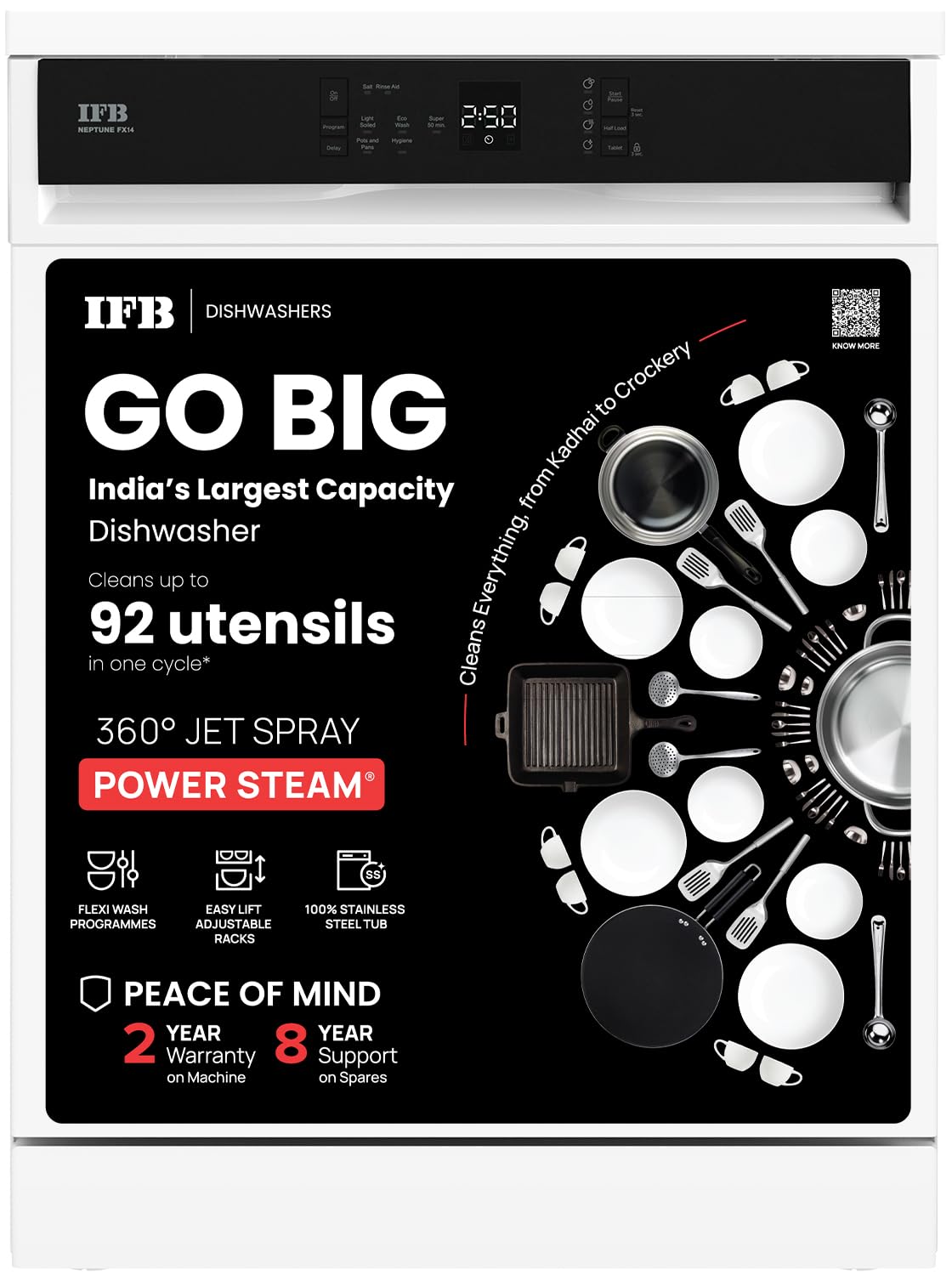
IFB Neptune FX14 14 Place Dishwasher with 70°C Hot Water Wash
Families of 4-6 wanting the highest-rated dishwasher at the lowest price
If you want an exact per-cycle kWh figure for a specific model you're considering, check that model's official energy label or manual. It is far more reliable than any third-party estimate.
Monthly Electricity Cost: A Realistic Range for Indian Households
Rather than modelling specific invented per-machine scenarios, here's a realistic range based on typical dishwasher energy-label consumption for this appliance class:
- Light use (Eco cycle, most days): roughly ₹120–₹180/month
- Typical use (mostly Normal cycle, daily): roughly ₹180–₹300/month
- Heavy use (Intensive cycle daily, larger capacity machine): roughly ₹280–₹400/month
Key insight: Even at the high end, monthly dishwasher electricity cost is a fraction of what a 1.5-ton AC adds for a few hours a day, and comparable to or less than the cost of heating water with a geyser for hand-washing the same volume of dishes (see below).
Indian Electricity Rate Reference 2026
Electricity rates vary significantly by state and consumption slab in India. Here is the relevant context:
| State | Residential Rate (₹/unit) | Notes |
|---|---|---|
| Delhi (BSES/TPDDL) | ₹3–₹8 | Slabs: 0–200 units cheap, 400+ units expensive |
| Mumbai (BEST/Adani) | ₹3.50–₹9 | Progressive slab structure |
| Bengaluru (BESCOM) | ₹4.50–₹8 | 200 free units for BPL; commercial rate higher |
| Hyderabad (TSSPDCL) | ₹3.10–₹8.50 | Significant slab variation |
| Chennai (TANGEDCO) | ₹0–₹6 | 100 free units; subsequent units ₹4–₹6 |
| Pune (MSEDCL) | ₹4–₹9 | Fixed charges apply above 300 units |
| Ahmedabad (UGVCL) | ₹4.50–₹8 | Rural and urban differ |
Important for slab calculations: A dishwasher can add roughly 20–45 units per month to your consumption. If your household already sits near a slab boundary, the additional units may push you into a higher rate tier. Check your current monthly consumption against your state's slab structure.
For example, a Delhi household consuming 190 units/month sits in the cheap ₹3/unit slab. Adding 30–40 units from a dishwasher can push total past 200 units — now some units are priced at the next slab's rate. The effective marginal cost of dishwasher electricity is the rate at your new consumption level, not the average.
Practical Tips to Reduce Dishwasher Electricity Consumption in India
1. Use Eco Mode for Daily Loads
Switch your default program from Normal to Eco. For typical Indian family dinner dishes (lightly to moderately soiled), Eco mode at 50°C cleans effectively and saves meaningfully on electricity versus Normal. Reserve Normal 60°C for heavier loads and Intensive 70°C only for very heavy Indian cooking residue.
2. Run Full Loads Only
A half-filled dishwasher uses almost the same energy as a full load — the heating element still needs to heat the same volume of water to the target temperature. Running half-loads effectively doubles your per-item energy cost.
Indian household tip: In smaller families (2–3 people) who generate fewer dishes per day, let dishes accumulate over the day and run one full cycle in the evening rather than running small loads twice a day.
3. Run at Night (Off-Peak If Your Utility Offers It)
Several Indian state electricity utilities offer time-of-use (ToU) pricing for residential customers — typically cheaper rates between 11 PM and 6 AM. Check with your state electricity board. If off-peak rates apply, schedule your dishwasher cycle via the timer function available on most modern machines — many current models, including the IFB Neptune FX14 and VX15 (up to 24 hours) and the LG DFB424FP, offer delay-start timers.
4. Skip the Heated Dry Cycle When Possible
Heated drying adds a meaningful chunk of energy per cycle on models that have it. Instead, open the dishwasher door immediately after the cycle ends — steam escapes and dishes air-dry naturally within 20 minutes. In dry climates (Delhi in summer, Rajasthan), this works perfectly. In humid coastal cities (Mumbai, Chennai during monsoon), you may need to towel-dry a few items.
5. Maintain the Machine for Peak Efficiency
A clogged filter or scaled heating element forces the machine to work harder and longer to reach target temperatures:
- Clean the filter monthly (located at the bottom of the tub — rinse under tap)
- Descale monthly with a dishwasher cleaner tablet
- Keep the water softener supplied with salt on models that have one — an ineffective softener means the heating element scales up, reducing heat transfer efficiency
Does a Dishwasher Consume More Electricity Than a Geyser?
Many Indian households use an electric geyser to heat water for hand washing dishes, especially in winter. Let us compare:
Electric geyser for hand washing hot water:
- 5-litre geyser (2kW) heating water for 15 minutes: roughly 0.5 kWh
- For 2–3 dish washing sessions per day: roughly 1.0–1.5 kWh/day
- Monthly: roughly 30–45 kWh at ₹7/unit = ₹210–₹315/month
Dishwasher (typical daily cycle): roughly ₹180–₹300/month, per the ranges above
The electricity consumption of a dishwasher is broadly comparable to using an electric geyser for hot water hand washing — and the dishwasher does a far better job of cleaning.
Frequently Asked Questions
Q1. How many units of electricity does a dishwasher consume per cycle in India?
Based on typical BEE/EU energy-label figures for this appliance class, a modern dishwasher generally consumes somewhere in the range of 0.6–1.8 units (kWh) per cycle depending on the program — Eco cycles at the low end, Intensive cycles at the high end. For an exact figure, always check the specific model's official energy label rather than a general estimate.
Q2. How much does a dishwasher increase my electricity bill in India?
Running one cycle per day typically adds somewhere in the range of ₹150–₹350/month to your electricity bill, depending on the program used and local rates. This is a fraction of what an air conditioner, water heater, or even a high-wattage microwave adds to your bill.
Q3. Is a 5-star (or A+++) dishwasher significantly more efficient than a lower-rated model in India?
Generally yes — a higher energy-rated model consumes meaningfully less electricity per cycle than a lower-rated one in the same capacity class. Over a 10-year lifespan, the saving can be substantial — often enough to offset some or all of the price premium of choosing a higher-rated model. Always check the energy label's stated annual consumption figure, not just the star/class rating alone.
Q4. What is the most electricity-efficient dishwasher in India?
Among the dishwashers we list, the three Bosch models are rated A+++, one class above the two IFB models (A++). The Bosch SMS66GW01I is rated at 292 kWh a year, about ₹210–₹240 a month at one cycle a day. Always check the specific model's own energy label before deciding, since ratings and figures update over time.
Related Articles
- Dishwasher vs Hand Washing India — Full Cost Comparison
- Bosch Dishwasher India Review
- Dishwasher and Hard Water in India — Complete Guide
- Best Dishwasher in India 2026
Related Reading
- Best Dishwasher in India 2026 — All models ranked, with running costs
- IFB vs Bosch Dishwasher India — Energy efficiency compared
Most Energy-Efficient Dishwasher for India
Bosch 13 Place Free-Standing Dishwasher, Intensive Kadhai Program (SMS66GW01I, White)
Families of 4-6 wanting the best-selling, well-proven dishwasher
See all dishwashers → Best Dishwasher in India 2026