Disclosure: This post contains affiliate links. If you buy through our links, we earn a small commission at no extra cost to you. Read our affiliate policy.
This is the question every Indian household asks before buying a dishwasher — and it is the right question. Western dishwasher reviews are largely useless here. They test pasta bowls and wine glasses, not kadhais with charred masala, tawas coated in ghee residue, or pressure cooker bodies with turmeric stains. Here's a grounded, honest look at what actually works, based on how these machines and cookware materials behave — not an invented lab test.
Quick Answer
Can a dishwasher clean Indian cooking utensils?
Yes — with important caveats. A dishwasher can generally clean stainless steel kadhais, pressure cooker bodies, serving bowls, and plates with typical Indian food residue, especially on a hot Intensive program. It struggles with heavily charred tawas and caramelised masala baked deep into kadhai walls over many cook cycles, and it cannot safely clean non-stick pans, copper vessels, iron tawas, or wooden utensils at all. The key is choosing a machine with a hot (70°C-class) Intensive wash program and pre-soaking heavily soiled items for 15–20 minutes before loading.
The Indian Cookware Challenge: Why It Is Different
Indian cooking creates some of the world's most dishwasher-hostile residues. Here is what we are dealing with:
1. Kadhai (Indian Wok) — The Toughest Test
A kadhai used for daily cooking accumulates:
- Charred masala rings from bhunofying (high-heat dry roasting of spices) at 250°C+
- Protein residue from paneer or chicken stuck to the curved walls
- Oil polymerisation — repeated heating of oil creates a semi-permanent plastic-like film on stainless steel
Dishwasher result: A dishwasher on a hot Intensive (70°C-class) program generally handles fresh masala residue and light charring reasonably well without pre-treatment. For heavier char, pre-soak the kadhai with hot water and a drop of dishwasher detergent for 20 minutes before loading — this meaningfully improves results on tougher residue.
What remains: Very heavy, multi-week carbon char on kadhai walls — the kind that has been baked in through dozens of cooking cycles — will not fully come off in a dishwasher. This requires periodic manual scrubbing regardless.
2. Tawa (Griddle) — Partially Successful
Iron tawas (the traditional black ones) should never go in a dishwasher — the water will rust them. Aluminium tawas are also problematic. However:
- Stainless steel tawas: Dishwasher cleans ghee residue and dough bits effectively on Intensive wash.
- Non-stick tawas: Hand-wash them. Dishwasher heat and detergent wear most non-stick coatings faster, and most non-stick makers recommend hand-washing.
3. Pressure Cooker — Surprisingly Good Results
The pressure cooker body (stainless steel) is one of the best items for the dishwasher — plain stainless steel generally responds very well to hot-cycle dishwashing regardless of brand (Hawkins, Prestige, Vinod, etc.).
What the dishwasher handles well:
- Inner stainless steel body — comes out spotlessly clean even after dal, biryani, and curry
- Stainless steel lid body (without gasket)
- Pressure release valve (small parts basket)
What to hand wash or remove before loading:
- Rubber gasket/sealing ring — hot dishwasher cycles degrade rubber faster than hand washing
- Whistle/weight valve — tiny part, use the small parts basket or hand wash
- Any painted exterior surfaces — paint will peel after repeated wash cycles
Brand note: Bosch, IFB and LG all show a 5 L pressure cooker in the lower rack of their loading diagrams. Check your cooker maker's care instructions too.
4. Rice and Dal Vessels
Stainless steel handi and degchi with stuck rice or dal generally respond well to an Intensive program, especially with a 15-minute cold water pre-soak (cold water prevents the starch from baking on further; do not rinse with hot water before loading).
5. Steel Plates, Katoris, and Glasses
This is where dishwashers shine brightest for Indian households. Stainless steel thali sets, katoris, and steel glasses generally come out gleaming — often cleaner than hand washing, which can leave grease smears.
How to Pre-Soak Heavy Indian Cookware
Pre-soaking is the secret weapon that makes Indian cookware dishwasher-compatible. Here is a practical protocol:
For kadhais and heavy pots:
- While still warm (not hot), pour 500ml of warm water into the utensil
- Add 1 teaspoon of dishwasher detergent powder or half a pod
- Let soak for 15–20 minutes — the warm detergent solution loosens polymerised oil and masala
- Load directly into the dishwasher without rinsing (the detergent helps the cycle)
- Run a hot program: Bosch's Intensive Kadhai (70°C) or IFB's Pots & Pans (65°C)
For rice vessels with stuck rice:
- Fill with cold water immediately after emptying (do not let it sit)
- Let soak 10 minutes — cold water prevents starch from hardening
- Load and run on Normal or Eco cycle (no need for Intensive — starch is water-soluble)
For glasses with tea/chai stains:
- No pre-soak needed — load directly, tea tannins dissolve easily at 60°C+
- Use rinse aid — essential for spot-free steel glasses
Top 3 Dishwashers for Indian Cooking
(These picks are based on each listing's specs and real Amazon ratings and sales, not on a hands-on lab test. Every one is rated 4.0★ or higher, with at least 100 reviews and at least 50 bought in the past month.)
#1 — Bosch SMS66GW01I (13 Place Settings) — Best Overall
The best-selling dishwasher we list (300+ a month) and ranked #1 in Full Size Dishwashers on Amazon India, with 4.2★ from 2,305 ratings.
Why it works for Indian cooking:
- Intensive Kadhai program at 70°C, built for oily Indian vessels
- Loading diagram shows a kadhai, a 5 L cooker and two tawas with a dinner set
- Hard water softener, load and aqua sensors, rated 44 dB and 9.5 L a cycle
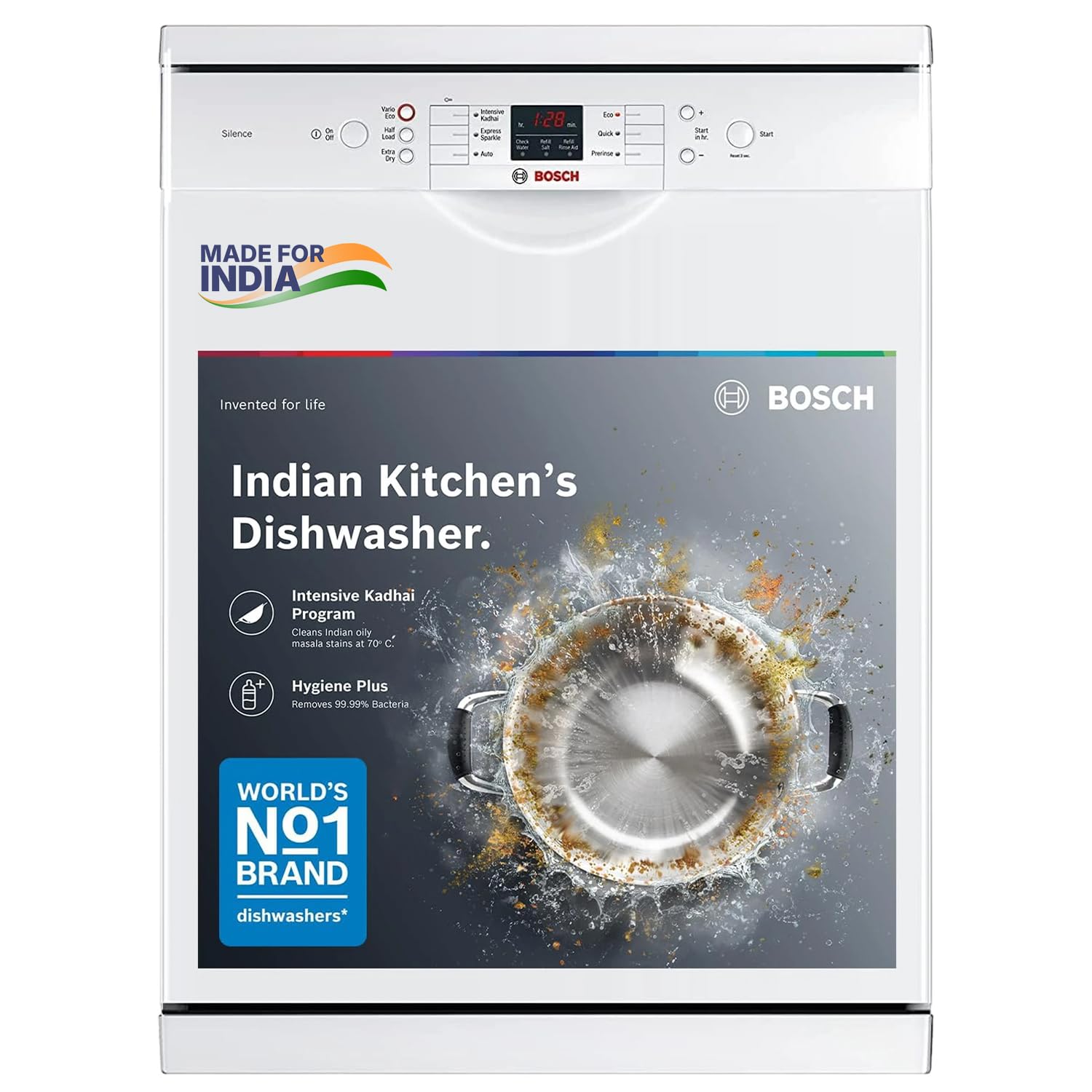
Bosch 13 Place Free-Standing Dishwasher, Intensive Kadhai Program (SMS66GW01I, White)
Families of 4-6 wanting the best-selling, well-proven dishwasher
The Bosch SMS66GI01I is the same machine in Silver Inox, with 3,047 ratings, for about ₹3,000 more.
#2 — IFB Neptune FX14 (14 Place Settings) — Best Value
The highest-rated dishwasher we list (4.4★ from 514) and the cheapest, at about ₹42,800.
Why it works for Indian cooking:
- Pots & Pans program at 65°C and Hygiene at 70°C
- 360° spray arm and hygienic steam drying
- Loading diagram shows a 5 L kadhai, a 5 L cooker, a tea container and a tawa
Honest caveat: it is rated 52 dB, louder than the Bosch.
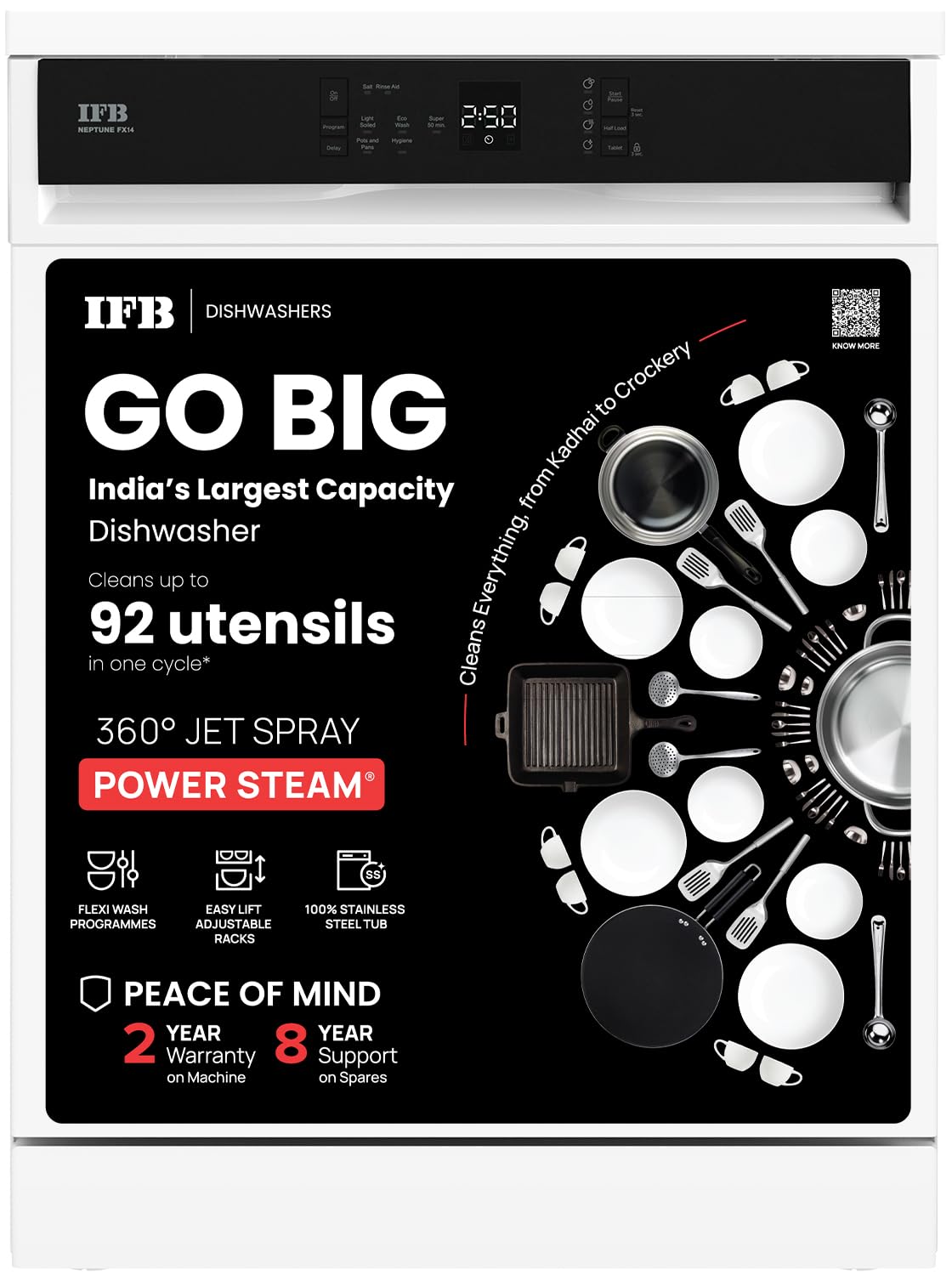
IFB Neptune FX14 14 Place Dishwasher with 70°C Hot Water Wash
Families of 4-6 wanting the highest-rated dishwasher at the lowest price
#3 — IFB Neptune VX15 (15 Place Settings) — For Big Loads
A 15 place IFB with a third cutlery tray, the same 70°C Hygiene and Pots & Pans programs, and 9 L a cycle, the lowest published water use we list. It has only 109 ratings (4.2★), so it is less proven. The Bosch SMS46KI03I is the other 15 place option: quieter and with a cutlery drawer, but about ₹12,000 more.
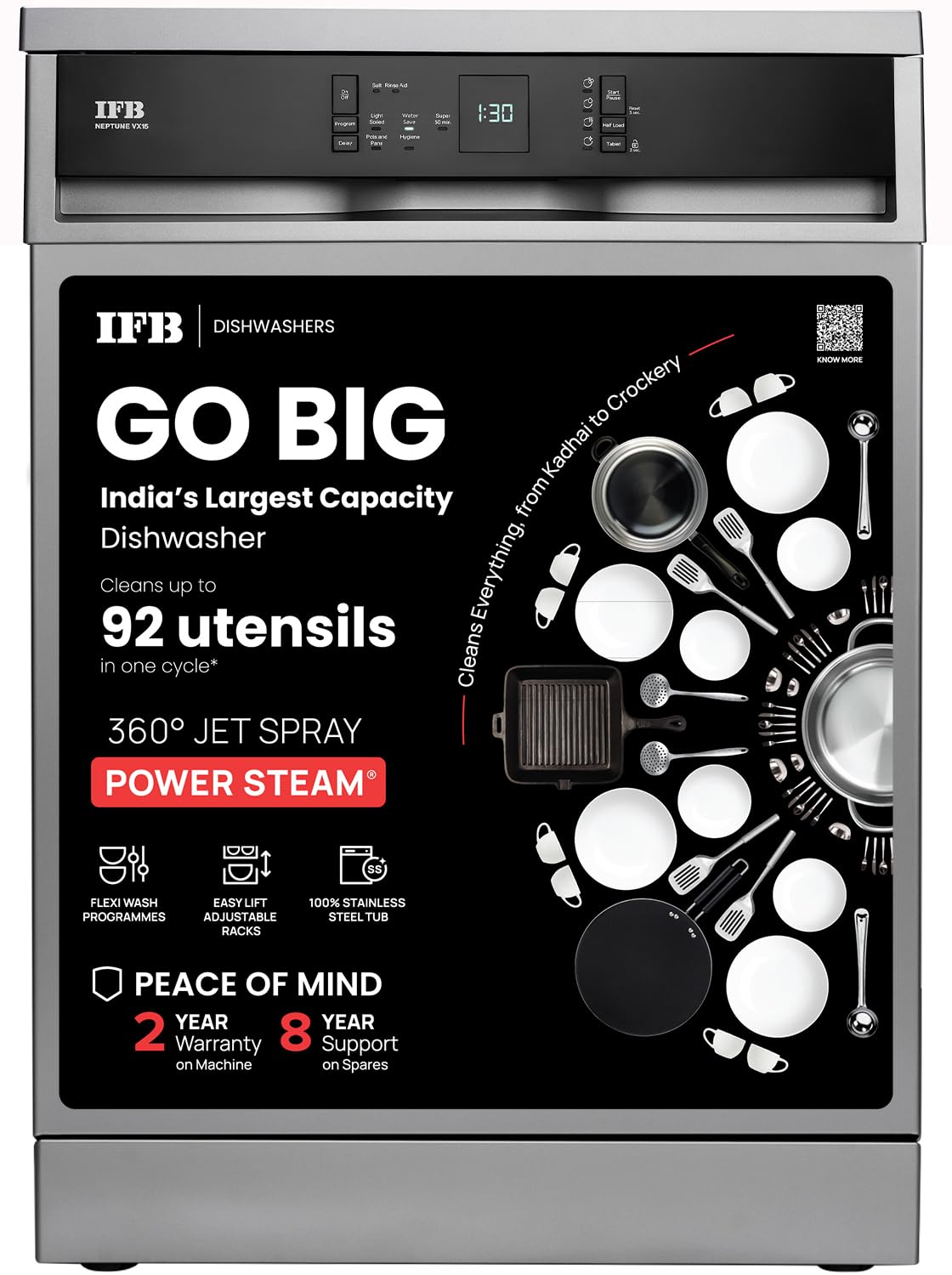
IFB Neptune VX15 15 Place Dishwasher with 3rd Cutlery Tray
Large families wanting 15 place settings and a cutlery tray for less than the 15 place Bosch
What CANNOT Go in a Dishwasher: The Indian Kitchen Blacklist
This is critically important. The following Indian kitchen items must never go in a dishwasher:
| Item | Reason | Alternative |
|---|---|---|
| Non-stick pans/tawas | Detergent destroys coating in 3–5 cycles | Always hand wash with soft sponge |
| Copper vessels (tamba) | Oxidises and turns black/green permanently | Hand wash with tamarind paste |
| Iron kadhai / tawa | Rusts immediately | Wipe with oil-soaked cloth only |
| Wooden spoons / spatulas | Wood cracks and warps from heat and moisture | Hand wash and air dry |
| Silver utensils (chandi) | Tarnishes and pits from dishwasher detergent | Polish cloth or mild soap |
| Bone china / antique crockery | Glaze cracks over time from heat cycles | Hand wash with cold water |
| Aluminium pots (anodised OK) | Corrodes and discolours in alkaline detergent | Non-anodised aluminium: hand wash only |
| Plastic containers (unless dishwasher-safe labelled) | Warp and release chemicals at 70°C | Check for dishwasher-safe symbol |
| Pressure cooker rubber gasket | Degrades rubber faster than hand washing | Hand wash and air dry separately |
Dishwasher Salt and Rinse Aid — Non-Negotiable for Indian Hard Water
No discussion of Indian dishwasher performance is complete without addressing hard water, which much of India has.
Dishwasher salt (not cooking salt) feeds the built-in water softener resin that strips calcium and magnesium from water before it reaches your utensils. Without it:
- White calcium film appears on stainless steel
- Kadhai and steel utensils develop a chalky, dull surface that looks unwashed
- Scale builds up inside the machine over time
Rinse aid reduces water surface tension so water sheets off dishes instead of forming droplets that leave mineral spots when they dry. For Indian utensils — particularly steel thalis and katoris — rinse aid is what gives you that gleaming, wet-look clean finish.
Recommended setup for Indian hard water cities (Delhi, Jaipur, Gurugram, Ahmedabad):
- Fill the salt reservoir fully and set the water hardness to match a TDS or hardness test of your water
- Keep the rinse aid reservoir topped up (monthly)
- Run a dishwasher cleaner through an empty hot cycle every month or two
Frequently Asked Questions
Q1. Can a dishwasher clean heavily stained Indian kadhais?
For fresh-to-moderately stained kadhais (day-old masala, normal cooking residue), a dishwasher on a hot Intensive program generally cleans effectively — often comparably to or better than hand scrubbing. For heavily charred, multi-cook-cycle carbon deposits, pre-soak the kadhai in warm water with a detergent pod for 20 minutes before loading, which meaningfully improves results. Extreme, multi-year char buildup will always need periodic manual scrubbing regardless of machine.
Q2. Can I put a pressure cooker in a dishwasher?
The stainless steel body and lid of most Indian pressure cookers (Hawkins, Prestige, Vinod) can go in the dishwasher safely. Always remove the rubber gasket/sealing ring and whistle separately — hand wash and air dry them. The rubber gasket degrades faster in dishwasher heat and detergent chemistry. Painted or aluminium pressure cookers should not go in a dishwasher.
Q3. Which wash program should I use for Indian cooking residue?
Use the hottest program for kadhais, heavily soiled pots and anything with masala stains: Intensive Kadhai (70°C) on Bosch, Pots & Pans (65°C) or Hygiene (70°C) on IFB, Intensive on LG. Use Auto or Eco for daily plates, katoris and steel glasses. Quick programs run too cool for oily Indian cookware.
Q4. Is IFB or Bosch better for Indian cooking?
Both have a 70°C program for Indian vessels. The Bosch SMS66GW01I is the best seller and quieter (44 dB). The IFB Neptune FX14 is rated higher (4.4★) and costs less, but is louder (52 dB). For 15 place settings, the IFB Neptune VX15 costs less than the Bosch SMS46KI03I. See our IFB vs Bosch comparison.
Related Articles
- Dishwasher and Hard Water in India — Complete Guide
- Dishwasher vs Hand Washing India — Cost Comparison
- Bosch Dishwasher India Review
- Best Dishwasher in India 2026
Related Reading
- Best Dishwasher in India 2026 — All models ranked for Indian cooking & hard water
- IFB vs Bosch Dishwasher India — Head-to-head comparison
Best Dishwashers for Indian Cooking
Best Overall — Bosch SMS66GW01I
Bosch 13 Place Free-Standing Dishwasher, Intensive Kadhai Program (SMS66GW01I, White)
Families of 4-6 wanting the best-selling, well-proven dishwasher
Best Value — IFB Neptune FX14
IFB Neptune FX14 14 Place Dishwasher with 70°C Hot Water Wash
Families of 4-6 wanting the highest-rated dishwasher at the lowest price
See all dishwashers → Best Dishwasher in India 2026