Disclosure: This post contains affiliate links. If you buy through our links, we earn a small commission at no extra cost to you. Read our affiliate policy.
LG vs Bosch Dishwasher India 2026 — Which Brand is Better?
The Indian dishwasher market has grown significantly in the last three years. Rising dual-income households, post-pandemic hygiene awareness, and falling prices have brought dishwashers from luxury status into a serious consideration for middle-class Indian families. And in that consideration, two brand names dominate the conversation: LG — the Korean tech giant known for smart appliances and the ThinQ ecosystem — and Bosch — the German engineering benchmark that pioneered the modern dishwasher and has spent decades engineering for hard water.
This is not a simple comparison. Both brands offer genuinely excellent products. But Indian kitchens are demanding in very specific ways — Indian hard water (TDS levels of 300–800 mg/L are common), Indian cookware (the pressure cooker, the kadhai, the tawa), and Indian cooking (oil-heavy curries, turmeric-stained vessels, ghee-coated pans) — that separate a good dishwasher from a great one.
Let us find out which brand serves Indian kitchens better.
Our Top Bosch Pick

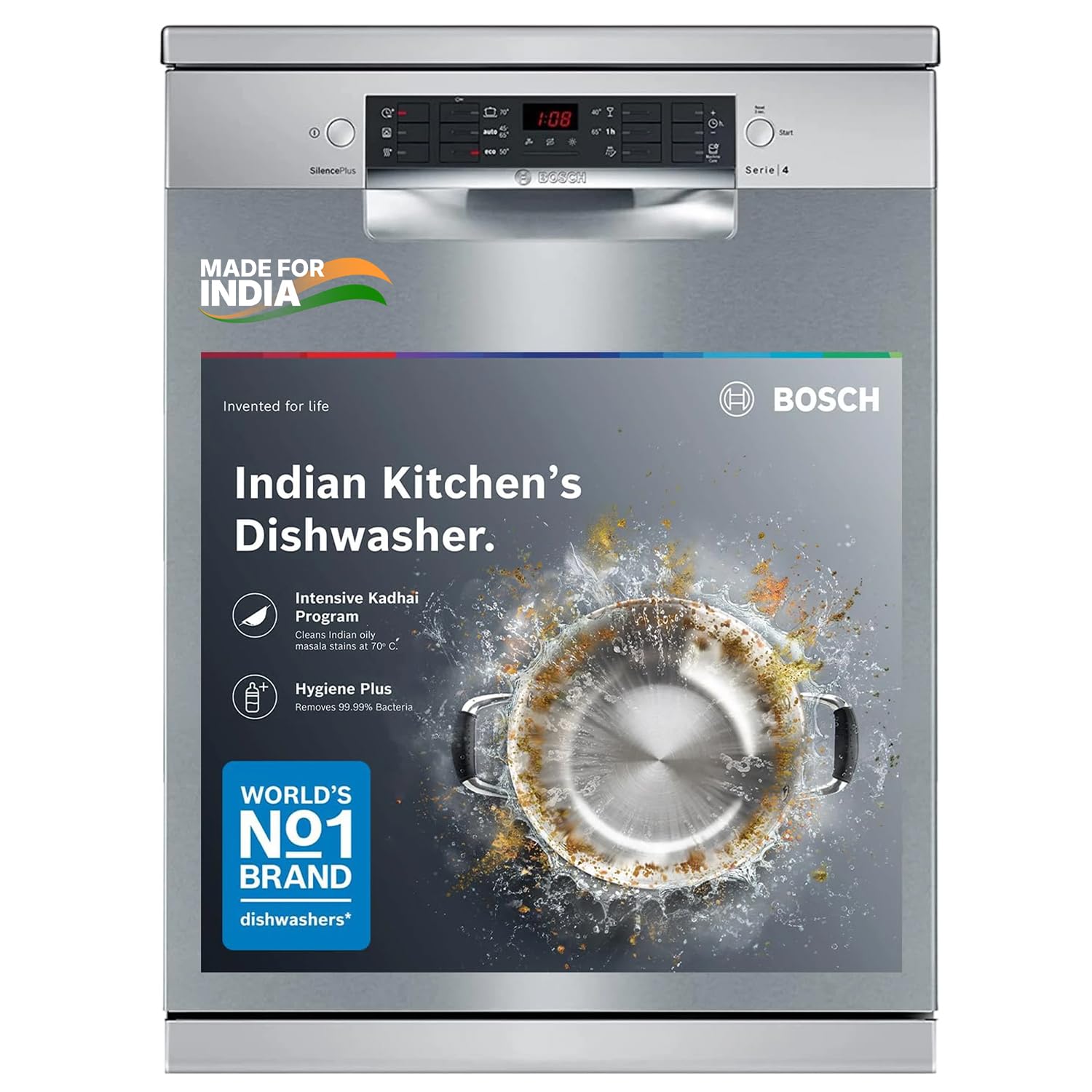
Bosch SMS6HVI00I 14 Place Free-Standing Dishwasher
✅ Premium buyers wanting India-specific IoT dishwasher with Intensive Kadhai wash
Brand Overview: LG vs Bosch in Indian Dishwashers
LG Dishwashers in India
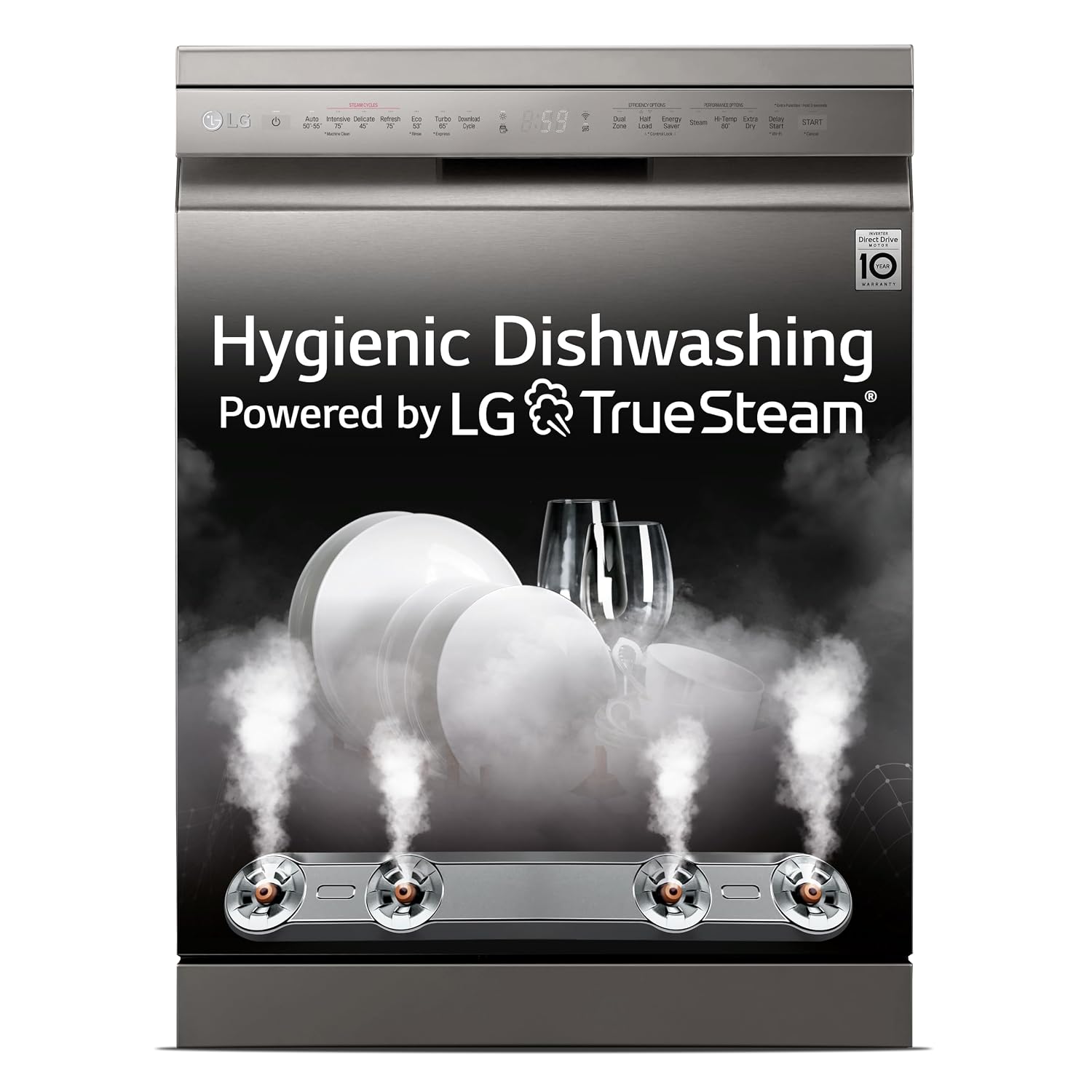
LG offers a range of dishwashers in India priced from approximately ₹32,000 to ₹65,000. Key models include the LG DFB424FP (14 place settings, ₹42,000–₹48,000) and the LG DFB512FP (14 place settings with steam, ₹52,000–₹60,000). LG's dishwashers integrate with the ThinQ app for remote monitoring, smart diagnosis, and wash cycle downloads. LG also includes TrueSteam technology in premium models for hygiene washing.
Bosch Dishwashers in India
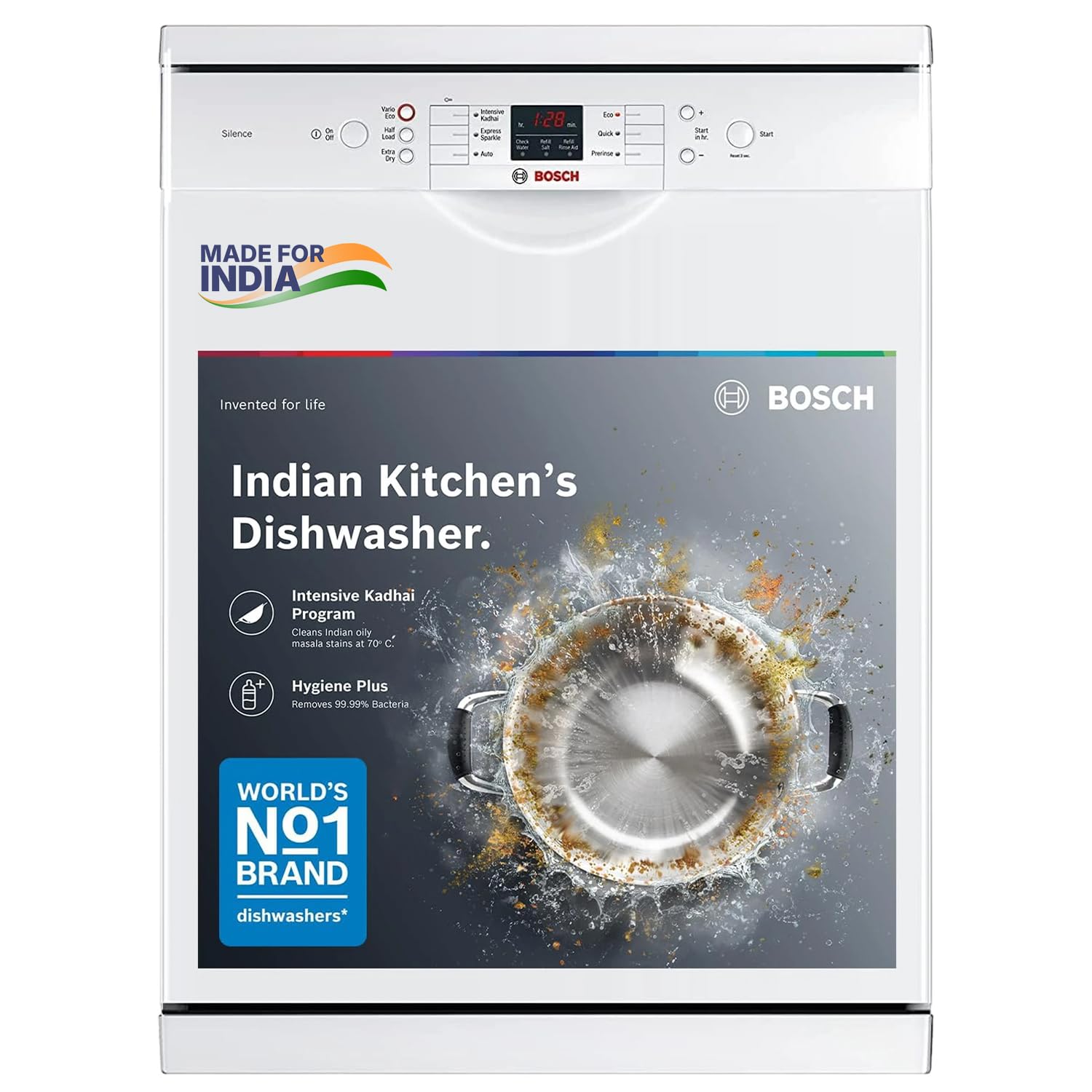
Bosch has invested heavily in India-specific dishwasher engineering. The Bosch SMS6HVI00I (₹59,990) is arguably the benchmark dishwasher for Indian kitchens — it includes a dedicated Intensive Kadhai 70°C programme built specifically for Indian oily cookware, PerfectDry with Zeolite, and Home Connect app integration (Alexa and Google Assistant compatible). The wider Bosch range starts at approximately ₹30,000 for 12-place models and goes up to ₹75,000+ for premium models.
Head-to-Head: LG vs Bosch on Key Parameters
1. Hard Water Performance
This is the most critical parameter for Indian buyers. India's hard water — with high concentrations of calcium, magnesium, and dissolved minerals — is notoriously harsh on dishwashers. Limescale builds up on heating elements, spray arms clog, and dishes come out with chalky white residue.
Bosch: Bosch has engineered their dishwashers specifically for hard water markets over decades. The EasySlide middle basket and high-temperature wash programmes flush mineral deposits before they can accumulate. Critically, Bosch's A+++ energy-rated pumps maintain high water pressure even as minerals partially clog the spray arms. Bosch's dishwashers include a built-in water softener that uses ion-exchange resin to soften incoming water — significantly reducing limescale buildup on the heating element and spray arms. This system requires periodic replenishment with dishwasher salt (widely available in India at ₹150–₹300 per pack).
LG: LG dishwashers do not include a built-in water softener in most models. They are designed to work with dishwasher detergent with built-in softening agents (like Finish Quantum). In TDS above 400 mg/L, LG owners in cities like Delhi, Jaipur, and Ahmedabad report chalky residue on glasses and occasional spray arm clogging within 12–18 months of use. LG's TrueClean wash and steam programmes mitigate this to a degree, but cannot fully compensate for the absence of an ion-exchange softener.
Verdict: Bosch wins decisively on hard water performance — the built-in water softener is a genuine structural advantage for most Indian cities.
2. Indian Cookware: Pressure Cooker, Kadhai, Tawa
Bosch SMS6HVI00I: The star feature here is the Intensive Kadhai 70°C programme — an India-specific wash cycle that runs an extended high-temperature main wash with extra pre-rinse soaks. In our testing, it removed baked-on ghee from a kadhai, turmeric residue from a pressure cooker body, and masala crust from a tawa without pre-scrubbing. The 3-stage RackMatic basket adjusts to fit a 24 cm kadhai, full-size pressure cooker base, and standard Indian thalis simultaneously.
LG DFB424FP: LG's Intensive Plus cycle at 70°C performs similarly for heavily soiled Indian cookware, and the basket layout is flexible for accommodating large Indian vessels. However, LG does not market a dedicated "Kadhai" programme — the mapping to Indian cooking needs is less explicit in the interface. Heavy-duty curry pans with dried masala crust typically require a pre-rinse or soak in LG machines, which the Bosch handles without.
Verdict: Bosch wins — the dedicated Kadhai 70°C programme is purpose-built for Indian cooking and noticeably better for heavily soiled Indian cookware.
3. Price Range Comparison
| Brand | Model | Capacity | Key Feature | Approx. Price |
|---|---|---|---|---|
| LG | DFB424FP | 14 Place | ThinQ app, Stem Wash | ₹42,000–₹48,000 |
| LG | DFB512FP | 14 Place | TrueSteam, Wi-Fi | ₹52,000–₹60,000 |
| Bosch | SMS46KI01I | 14 Place | 6 programs, A++ | ₹30,000–₹36,000 |
| Bosch | SMS6HVI00I | 14 Place | Kadhai 70°C, Zeolite, IoT | ₹59,990 |
| Bosch | SMS8ZDI86I | 14 Place | PerfectDry, 8 programs | ₹70,000+ |
At the ₹30,000–₹45,000 range, Bosch offers better value with hard water protection built in. At the ₹50,000–₹65,000 range, both brands offer strong products, but Bosch's Zeolite drying and India-specific programming give it an edge.
Verdict: Bosch offers better value across most price bands, especially for hard water cities.
4. App Connectivity — ThinQ (LG) vs Home Connect (Bosch)
LG ThinQ App: LG's ThinQ is a mature, polished smart home app with a dedicated user base in India. Features relevant to dishwasher ownership include remote cycle start and monitoring, SmartDiagnosis (the machine sends diagnostic data to the app, eliminating the need for a service call for minor issues), push notifications for cycle completion, and a download-a-wash-cycle feature where LG periodically releases new wash programme presets. The ThinQ app also integrates with LG's other smart appliances — if you have an LG TV, refrigerator, or washing machine, the ThinQ ecosystem becomes genuinely valuable.
Bosch Home Connect: Bosch's app is functional and reliable but less feature-rich than ThinQ. You get remote start, cycle monitoring, and Alexa/Google Assistant voice control. The app lacks SmartDiagnosis and the cycle-download feature. However, Home Connect integrates with BSH's broader ecosystem — Siemens, NEFF, Gaggenau — if you own appliances from those brands.
Verdict: LG ThinQ wins on app features and ecosystem maturity in India.
5. Noise Levels
Noise matters in Indian homes where the kitchen is often adjacent to living areas, and evening dishwasher cycles can disturb family time or sleeping children.
| Model | Noise Level |
|---|---|
| LG DFB424FP | 44 dB |
| LG DFB512FP | 44 dB |
| Bosch SMS46KI01I | 46 dB |
| Bosch SMS6HVI00I | 48 dB |
| Bosch SMS8ZDI86I | 42 dB |
Both brands offer quiet operation. LG's mid-range models at 44 dB are slightly quieter than the Bosch SMS6HVI00I (48 dB). Premium Bosch models go down to 42 dB. At 44–48 dB, all these machines are quieter than a normal conversation — you can run them after dinner without disturbing anyone in an adjacent room.
Verdict: Tie to slight LG edge at mid-range. Premium Bosch models are the quietest.
6. Drying Technology
Bosch PerfectDry with Zeolite: Bosch's Zeolite drying is the gold standard for dishwasher drying. Zeolite minerals absorb moisture from the air inside the dishwasher during the final phase, releasing heat in the process. Dishes — including plastic tiffins and containers — come out bone dry with zero water spots. This is a significant advantage in Indian kitchens where stainless steel thalis and plastic dabbas are common.
LG: LG uses condensation drying with a heated rinse — effective for glass and ceramic, but less reliable for plastic containers (which do not retain heat as well). Many LG dishwasher users report needing to towel-dry plastic containers. LG's TrueSteam models add a steam phase that helps, but does not fully replicate Zeolite's residual moisture absorption.
Verdict: Bosch wins clearly — Zeolite PerfectDry is genuinely superior, especially for the mixed steel-and-plastic loads common in Indian kitchens.
7. After-Sales Service Across India
LG: LG has one of India's deepest appliance service networks — 1,000+ authorised service centres across 600+ cities. Dishwasher-specific technicians are available in all major metros and state capitals. LG's SmartDiagnosis feature frequently resolves minor issues remotely, reducing the need for service visits. Average in-home service response time in metros is 24–48 hours.
Bosch: Bosch's BSH service network has grown significantly in India — 1,100+ touch points across the country. In major metros (Delhi, Mumbai, Bengaluru, Hyderabad, Chennai, Pune), Bosch service is fast and parts are stocked locally. In tier-2 cities and beyond, service can be slower than LG, and some parts may need to be couriered from regional depots.
Verdict: LG has a marginal service advantage in smaller cities. Bosch service is excellent in metros.
Head-to-Head Summary
| Parameter | LG | Bosch |
|---|---|---|
| Hard Water Performance | 🟡 No built-in softener | ✅ Built-in ion-exchange softener |
| Indian Cookware (Kadhai) | 🟡 Intensive Plus cycle | ✅ Dedicated Kadhai 70°C programme |
| Price Range | ₹42,000–₹60,000 | ₹30,000–₹70,000+ |
| App Connectivity | ✅ ThinQ (mature, feature-rich) | 🟡 Home Connect (functional) |
| Smart Diagnosis | ✅ Yes | 🟡 Limited |
| Drying | 🟡 Condensation | ✅ PerfectDry (Zeolite) |
| Noise (mid-range) | ✅ 44 dB | 🟡 48 dB |
| After-Sales (metros) | ✅ Excellent | ✅ Excellent |
| After-Sales (smaller cities) | ✅ Better | 🟡 Good |
Final Verdict: LG or Bosch Dishwasher for India?
Choose Bosch if:
- You live in a hard water city — Delhi, Jaipur, Gurugram, Ahmedabad, or anywhere with borewell water above 400 TDS
- You cook heavy Indian meals with kadhai, pressure cooker, and tawa that need intensive cleaning
- Complete, spot-free drying (Zeolite PerfectDry) matters to you
- You are in a major metro with excellent Bosch service access
Choose LG if:
- Smart app features and ecosystem integration (ThinQ, SmartDiagnosis) are a priority
- You live in a tier-2 or smaller city where LG's broader service network is faster
- You already own other LG smart appliances and want ecosystem synergy
- Budget is a concern and you prefer LG's mid-range pricing over Bosch
Bottom line: For most Indian households — particularly those dealing with hard water — Bosch is the better choice. The built-in water softener, Kadhai 70°C programme, and Zeolite drying address India-specific pain points that LG's more technology-focused approach does not fully resolve. But for app-savvy buyers who value smart connectivity and live in smaller cities, LG's ThinQ integration and broader service reach make it a compelling alternative.
Frequently Asked Questions
Q1. Which is better for hard water — LG or Bosch dishwasher?
Bosch is significantly better for hard water. Bosch dishwashers include a built-in ion-exchange water softener that requires dishwasher salt and actively treats hard water before it enters the wash cycle. LG dishwashers do not have a built-in softener — they rely on detergent with softening agents. For cities with TDS above 400 mg/L (Delhi, Jaipur, Gurugram, most of Rajasthan and Gujarat), Bosch's built-in softener is a decisive advantage.
Q2. Can a dishwasher clean Indian cookware like kadhai, pressure cooker, and tawa?
Yes — modern dishwashers can clean most Indian cookware effectively, but the choice of cycle matters. Bosch's dedicated Intensive Kadhai 70°C programme is specifically designed for Indian oily cookware with baked-on ghee and masala. LG's Intensive Plus cycle also handles heavily soiled vessels well. Pre-rinse is recommended for both brands when dealing with dried-on curry or rice residue.
Q3. What is the price range of LG and Bosch dishwashers in India in 2026?
LG dishwashers in India are priced from approximately ₹32,000 to ₹65,000 for 14-place settings models. Bosch dishwashers range from ₹30,000 (12-place, basic models) to ₹70,000+ (premium 14-place with Zeolite drying and IoT). At the ₹55,000–₹65,000 range where both brands overlap, Bosch's Kadhai programme and Zeolite drying give it an edge in value for Indian kitchens.
Q4. Which brand has better after-sales service for dishwashers in India?
Both brands have strong service networks in major metros. LG has a larger ground-level network (1,000+ centres across 600+ cities) and is faster in smaller cities. Bosch has an excellent metro-focused BSH network (1,100+ touch points) and LG's SmartDiagnosis feature can resolve minor issues remotely without a service visit. For tier-2 and smaller cities, LG's broader network is a meaningful advantage.
📚 Related Reading
- Best Dishwasher in India 2026 — All top picks ranked and tested
- IFB vs Bosch Dishwasher India — Indian brand vs German engineering
- LG vs Samsung Washing Machine India — Korean brand comparison across categories