Disclosure: This post contains affiliate links. If you buy through our links, we earn a small commission at no extra cost to you. Read our affiliate policy.
Most chimney shopping stops at suction capacity — "1200 m³/hr" sounds more powerful than "1000 m³/hr," so it gets picked. But suction rating is measured at the motor, not at your stove. A powerful chimney with a long, bent, or undersized duct run can perform worse in your actual kitchen than a weaker chimney with a short, straight duct. Ducting is the part almost nobody researches, and it's the part that determines whether the suction number on the box means anything at all.
The Honest Answer First
| Your Situation | Recommended Setup | Why |
|---|---|---|
| Independent house/villa with an exterior wall behind the hob | Ducted | Shortest possible duct run, fumes genuinely leave the building |
| Apartment with a shared duct riser (common in newer buildings) | Ducted, into the riser — check society rules first | Same real removal of fumes, shared exhaust infrastructure |
| Apartment/rental with no external wall access near the hob | Ductless (charcoal filter) | No wall-breaking, no landlord permission needed for venting |
| Undecided, or might move the kitchen layout later | Convertible model (ducted-or-ductless) | Keeps both options open; add a duct later without buying a new chimney |
Ducted Chimneys — Fumes Actually Leave the Kitchen
How ducted works
A rigid or semi-flexible pipe carries the captured smoke, oil vapour, and heat from the chimney's outlet, through the wall or a ceiling/duct riser, to the outside. Nothing is recirculated back into the kitchen.
What ducted gets right
- ✅ Genuinely removes heat, humidity, and cooking fumes from the home — not just oil particles
- ✅ No recurring filter-replacement cost for odour control (baffle filters need washing, not replacing)
- ✅ Performs at closer to its rated suction capacity, if the duct run is short and straight
Ducted's real trade-offs
- ⚠️ Needs a path to an exterior wall, window, or shared duct riser — not always available, especially in older apartments or rentals
- ⚠️ Installation is more invasive: wall drilling, duct routing, sometimes a carpenter to box in the pipe
- ⚠️ Effective suction drops with duct length and every bend — see the sizing section below. A "1000 m³/hr" chimney with a long, bent duct run can deliver noticeably less than that at the hob.
Real ducted options
Faber Pluto 60cm — the budget-friendly ducted pick: a baffle-filter chimney (washable, no filter replacement cost) with touch and gesture control, rated 4.6★ and selling 500+ a month at about ₹8,500.
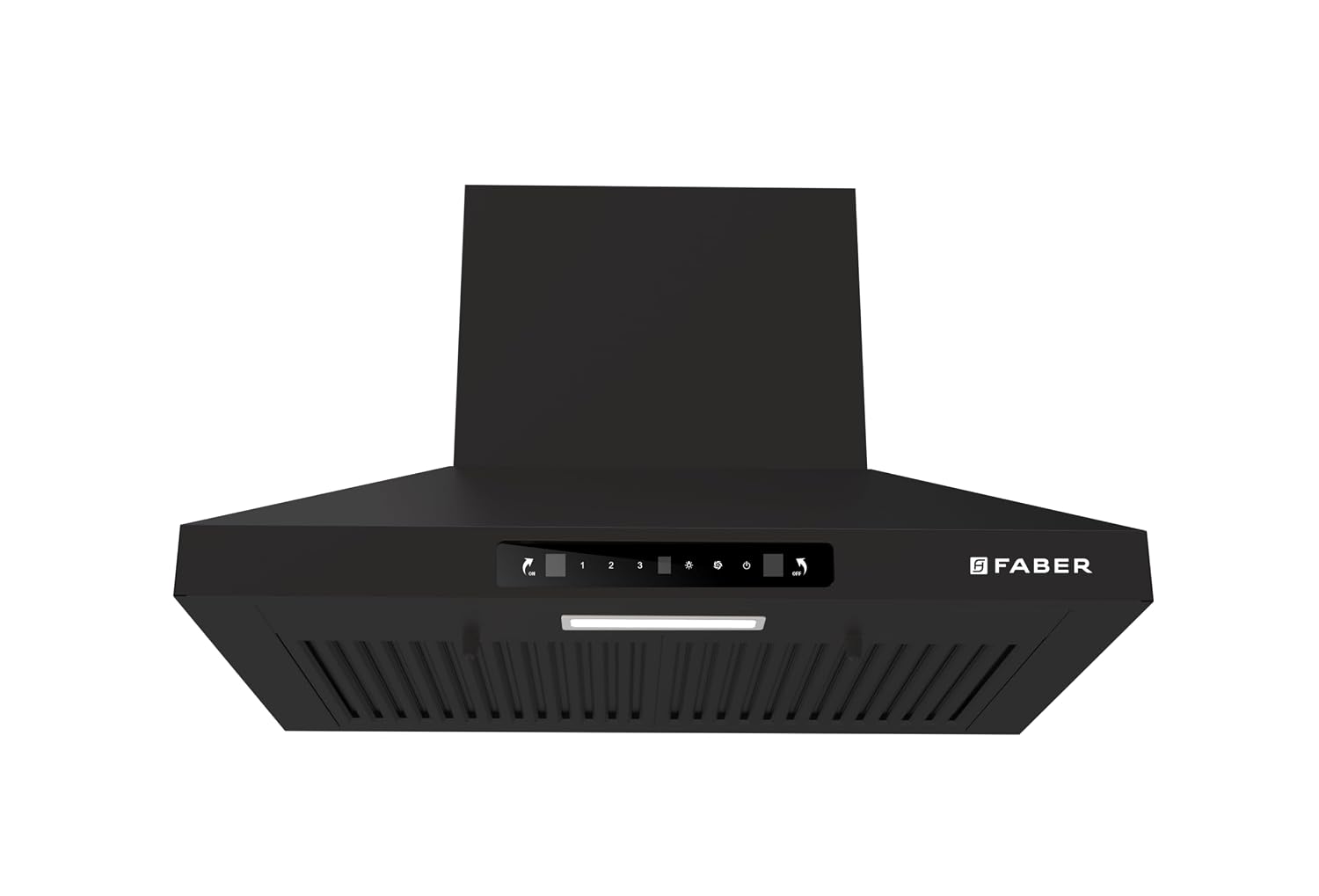
Faber Pluto 60cm 1000 m³/hr Baffle Filter Chimney with Touch and Gesture Control
Budget buyers wanting a well-rated, best-selling Faber
Elica WDFL 606 — a stronger, filterless auto-clean ducted option for households wanting higher suction (1,350 m³/hr) without a baffle filter to wash weekly.
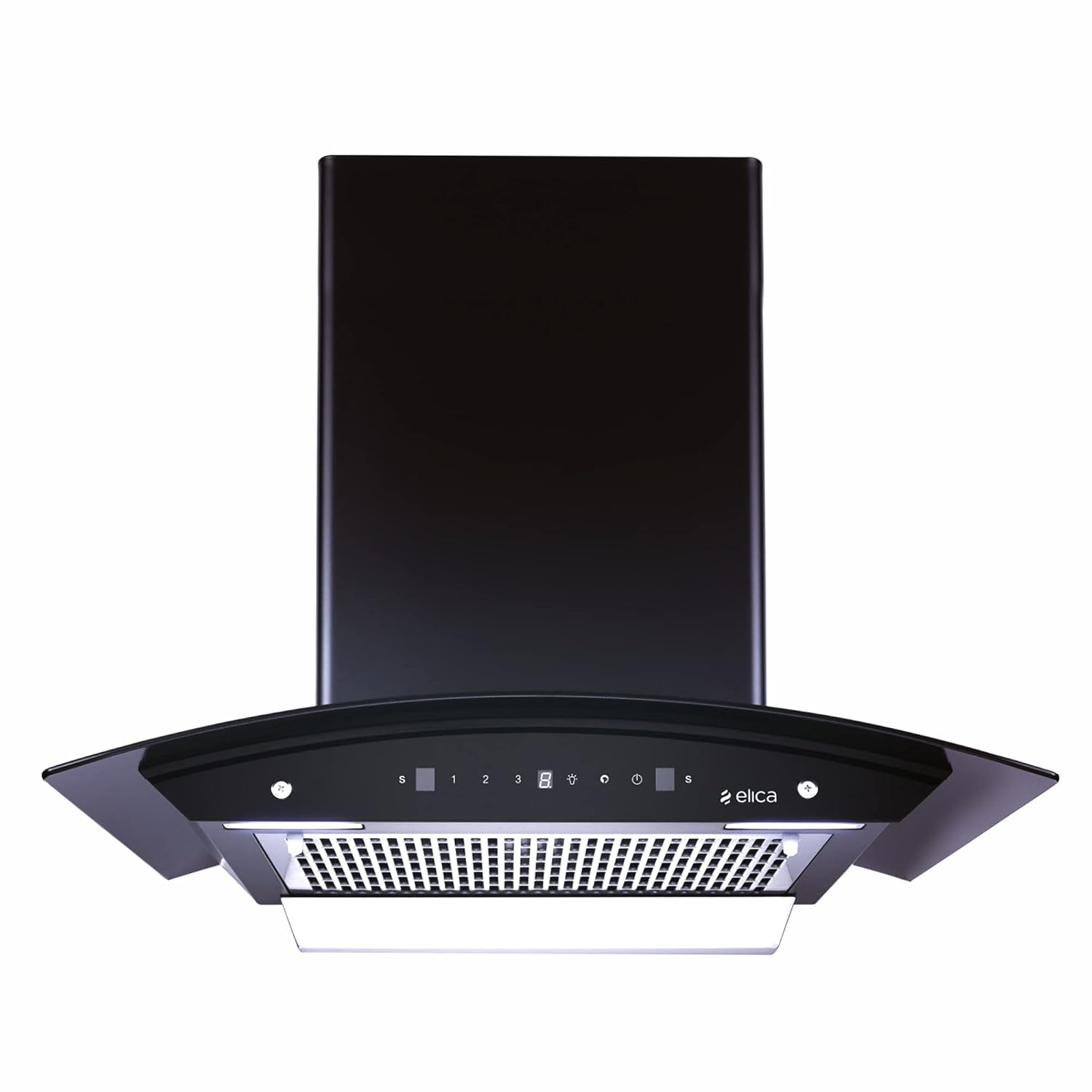
Elica 60cm 1350 m³/hr Filterless Autoclean Kitchen Chimney (WDFL 606 HAC LTW MS NERO)
Buyers wanting the most-reviewed chimney we list
Ductless (Recirculating) Chimneys — No Wall Access Needed
How ductless works
Instead of venting outside, the chimney pulls air through an activated-charcoal filter that traps oil and odour, then blows the filtered air straight back into the kitchen. Nothing physically leaves the building.
What ductless gets right
- ✅ Install anywhere — no exterior wall, window, or duct riser required
- ✅ No landlord or society permission needed to cut a vent
- ✅ Genuinely "plug and play" in most cases — the fastest installation of the two types
Ductless's real trade-offs
- ❌ Heat and humidity stay in the kitchen — only oil particles and some odour are filtered; the actual hot, humid air is recirculated, not removed
- ❌ Charcoal filters need periodic replacement (how often varies by brand: check the replacement interval and filter price before buying) — a recurring cost ducted baffle-filter models don't have
- ⚠️ Real-world odour/smoke clearing is generally weaker than a comparable ducted setup, even at the same rated suction
Real ductless option
Beyond Appliances Cube Pro — explicitly built as ductless, plug-and-play, with a 5-stage activated charcoal filter — no external venting required at all. We also list the Beyond Cube BLDC and the Elica Kitty Plug N Play, both ductless with BLDC motors.
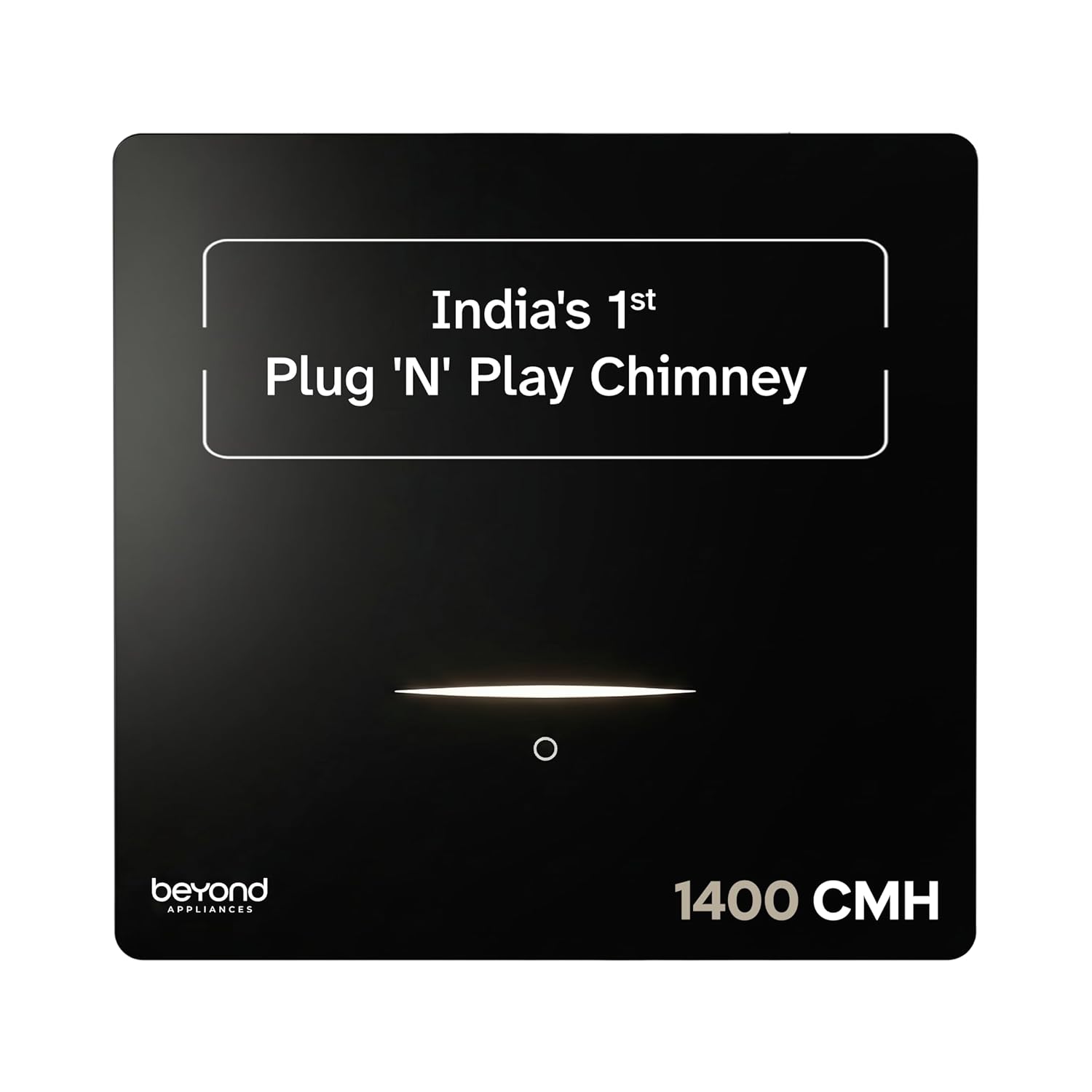
Beyond Appliances Cube Pro Plug N Play Ductless Kitchen Chimney (1400 CMH)
Renters and homes with no duct outlet who want a chimney without core cutting
Convertible Models — Ducted or Ductless, Your Choice
Some chimneys ship duct-ready but sell the charcoal filter kit separately, so you can install ducted now and switch to ductless later (or vice versa) without replacing the whole unit — useful if you're not yet sure whether you'll have exterior access, or if you might renovate later.
Elica WDFL 600 BLDC — filterless, BLDC motor (quieter, more energy-efficient), works ducted or ductless with a separately-sold charcoal filter kit.
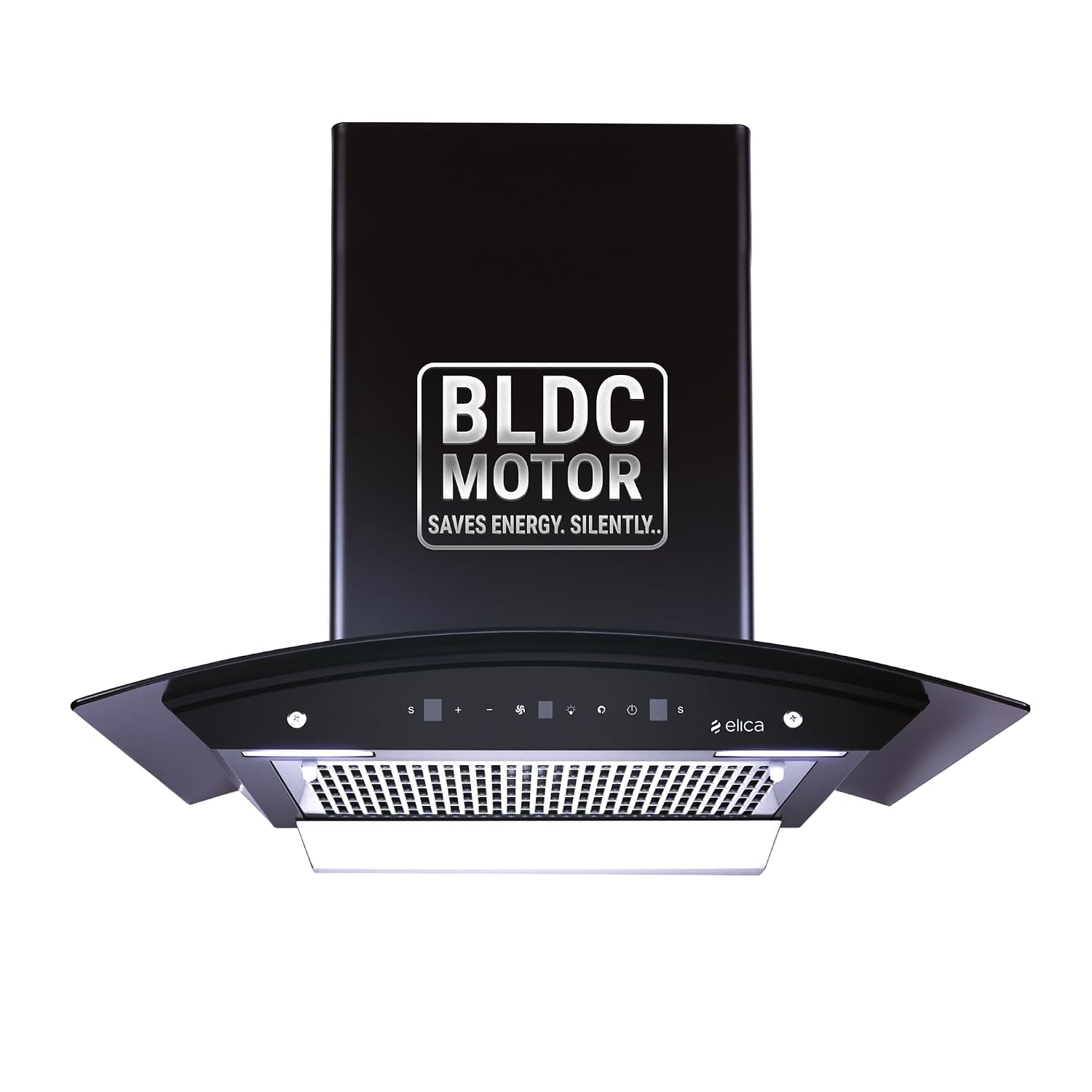
Elica 60cm 1500 m³/hr BLDC Filterless Autoclean Kitchen Chimney (WDFL 600 BLDC HAC LTW MS NERO)
Most families with a 2-4 burner stove wanting a quiet, low-maintenance chimney
Duct Pipe Sizing and Routing — What Actually Affects Suction
This is the part most buyers never see explained. A chimney's rated suction capacity (m³/hr) is measured under ideal lab conditions — a short, straight duct with no obstructions. Real kitchens rarely match that.
Pipe diameter
Most chimneys in the 1000–1800 m³/hr range are designed around a 6-inch (150mm) round duct, or a rectangular equivalent of similar cross-sectional area. Using a narrower pipe than the chimney is designed for chokes airflow regardless of motor power — check your chimney's manual for the recommended diameter before buying ducting separately.
Rigid vs flexible ducting
Rigid PVC or aluminium ducting has a smooth interior and loses less suction over distance. Flexible corrugated aluminium ducting (the cheaper, more common option) has a ridged interior that creates turbulence and measurably reduces effective airflow — the longer the run, the bigger the difference. For duct runs longer than a couple of metres, rigid ducting is worth the extra cost.
Bends cost real suction
Every 90° bend in a duct run acts like several extra feet of straight pipe in terms of airflow resistance. As a practical rule: keep the duct run as short and as straight as possible. One or two gentle bends to reach an exterior wall is normal and fine; three or more sharp bends to route around a false ceiling or cabinet will visibly cut into real-world suction, even on a chimney with a high rated capacity.
Duct length
Longer runs lose more suction to friction, even in a straight rigid pipe. If your hob-to-exterior-wall distance is long (routing through a false ceiling to a window on the far side of the kitchen, for example), consider a chimney rated meaningfully above what a simple room-size calculation would suggest, to compensate for the loss.
A backdraft damper at the outside end
A one-way flap (damper) at the exterior duct opening stops outside air, insects, and cooking smells from neighbouring kitchens blowing back in when the chimney is off. Cheap, easy to miss, and not always included — worth asking for specifically during installation.
Before You Buy: Installation Checklist
- Measure the actual duct run — hob to the nearest usable exterior point, including any bends — before assuming a straight-wall installation.
- Check for a pre-cut vent or duct riser — many newer apartments already have a designated kitchen exhaust opening; older buildings and independent houses usually don't.
- Check society/RWA rules if you live in an apartment — some housing societies restrict wall drilling or exterior venting on shared facades.
- Ask what's included — most listings cover the chimney unit only; a few (like the KAFF KEC 60A, which ships with a duct pipe and wall bracket) include ducting hardware. For everything else, budget separately for pipe, brackets, and installation labour.
- If ducted access genuinely isn't possible, choose ductless deliberately rather than as an afterthought — and factor in the recurring charcoal filter cost over the chimney's lifetime, not just the sticker price.
Ducted vs Ductless — Complete Comparison
| Ducted | Ductless (Recirculating) | |
|---|---|---|
| Removes heat & humidity from kitchen | ✅ Yes | ❌ No — recirculated |
| Removes oil & odour | ✅ Yes | ✅ Yes (via charcoal filter) |
| Needs exterior wall/vent access | ✅ Yes | ❌ No |
| Recurring filter cost | ❌ None (baffle filters are washable) | ✅ Replacement charcoal/carbon filters (intervals vary: Beyond rates its filter for 4 years; others need changing far sooner) |
| Installation complexity | Higher — wall drilling, duct routing | Lower — often plug and play |
| Suitable for rentals | ⚠️ Only with landlord permission | ✅ Yes |
| Real-world performance vs rated suction | Closer to rated, if duct is short & straight | Generally weaker at the same rating |
Frequently Asked Questions
Does duct length actually matter that much? Yes. A chimney's rated suction is measured under ideal conditions with a short, straight duct. Every additional metre of duct run, and every bend, adds airflow resistance — a long or heavily-bent duct run can noticeably reduce real-world performance below the rated m³/hr figure.
Is ductless as effective as ducted? For oil and odour trapping, ductless can come close with a good charcoal filter. For actually removing heat and humidity from the kitchen, no — a ductless chimney recirculates that air rather than expelling it, which a ducted chimney does by design.
What size duct pipe do I need? Most chimneys in the common 1000–1800 m³/hr range are designed for a 6-inch (150mm) duct. Always check your specific chimney's manual — an undersized duct chokes airflow no matter how powerful the motor is.
Can I convert a ducted chimney to ductless later, or vice versa? Only if the model is explicitly designed as convertible, with a charcoal filter kit sold separately for ducted-or-ductless use. A chimney built specifically for one mode generally can't be retrofitted for the other.
Do I need a professional to install ducting? For anything beyond a very short, straight run through an adjacent wall, yes — wall drilling, duct routing through cabinets or false ceilings, and correctly sealing the exterior vent are easy to get wrong, and a poorly sealed duct leaks suction (and lets outside air/smells back in).
All specs and prices verified against Amazon India listings and brand spec sheets as of September 2026.
Related Reading
- Best Kitchen Chimneys in India 2026 — All Models — All models we track, with live prices
- Best Kitchen Chimney Under ₹10,000 — Budget-focused baffle filter picks
- Faber vs Elica Chimney India — The two biggest chimney brands compared head-to-head