Disclosure: This post contains affiliate links. If you buy through our links, we earn a small commission at no extra cost to you. Read our affiliate policy.
Every air fryer guide tells you how to cook. Almost none of them tell you how to deal with what's left in the basket after you've made chicken tikka, murukku, or a batch of heavily spiced aloo tikki.
Indian cooking is hard on air fryer baskets. Turmeric leaves permanent-looking yellow stains. Masala marinades bake onto the basket coating in a way that water and dish soap alone cannot fix. Oil from ghee or mustard oil polymerises at high temperatures and turns into a varnish-like residue that gets harder to remove with every subsequent cook.
If you're using your air fryer for Indian cooking and cleaning it the way the instruction manual says (a quick wipe with a damp cloth), you're slowly building up a layer of burnt oil and masala residue that will shorten the basket's life, cause smoke during cooking, and make your food taste slightly off.
This guide gives you the exact cleaning methods that work — step by step, with the specific ingredients found in every Indian home.
Why Indian Cooking Makes Air Fryers Harder to Clean
Before the cleaning methods, it helps to understand why your air fryer basket looks the way it does after a week of Indian cooking.
Turmeric (haldi): Curcumin — the compound that gives turmeric its colour — is fat-soluble and heat-stable. It bonds chemically to porous non-stick surfaces at cooking temperatures. A cold water wash after cooking does almost nothing. You need acid (lemon) or an abrasive-safe paste to lift it.
Masala marinades: A typical tikka or tandoori marinade has curd, oil, ginger-garlic paste, and multiple spices. At 180–200°C, this mixture caramelises, then chars onto the basket surface. The longer you leave it after cooking, the harder it gets to remove — the sugars in the curd and ginger-garlic paste essentially caramelise into a light caramel coating that polymerises further with each reheat.
Mustard oil and ghee: Both have lower smoke points than refined oil and contain compounds that polymerise more aggressively at air fryer temperatures. They create the brownish-black varnish layer you see on the basket sides after repeated use. This layer is not harmful to eat — but it creates smoke, absorbs into food flavour, and traps bacteria if not removed.
The result: An air fryer used for Indian cooking needs 2–3x more aggressive cleaning than one used for frozen fries or vegetables. The instruction manual approach (wipe with damp cloth) is completely inadequate.
After Every Use: The Mandatory 3-Minute Routine
This is non-negotiable. If you do nothing else from this guide, do this:
Immediately after cooking (while the basket is still warm — not hot, not cold):
- Remove the basket. Set it on a heatproof surface.
- Pour out any pooled oil from the basket interior. Even if you used minimal oil, there will be rendered fat from the protein or marinade. Discard this — do not pour it down the drain, it will coat your pipes over time.
- Soak in hot soapy water — not barely warm, genuinely hot. Fill the basket with hot water and a few drops of dish soap (Vim, Pril, or any good grease-cutting soap). Let it sit for 3 minutes.
- Wipe with a soft cloth or non-scratch sponge. Most of the day's residue will come off easily at this stage, because the residue hasn't had time to harden.
- Rinse with hot water. Dry immediately. Do not leave the basket wet — water sitting in the basket can rust the non-stick coating's edge (where the coating meets the metal frame) over time.
Total time: 3 minutes. This single habit will keep your basket in good condition for 2–3 years instead of 6–8 months.
What happens if you skip it: The residue from each cook hardens as it cools, then gets baked harder in the next session. After 10–15 skipped cleanings, you'll have a thick layer of carbonised masala and polymerised oil that requires aggressive cleaning to remove — and aggressive cleaning risks damaging the coating.
Weekly Deep Clean: Baking Soda Paste for Stubborn Masala Residue
Once a week, do this deeper clean for accumulated residue that the daily wipe doesn't fully address:
The Baking Soda Paste Method
What you need: Baking soda (sodium bicarbonate, available at any kirana store), dish soap, soft cloth or old toothbrush.
Method:
- Make a paste: 2–3 tablespoons of baking soda + a small squeeze of dish soap + just enough water to form a thick, spreadable paste (not runny).
- Apply the paste generously to all stained or residue-coated areas of the basket — inside the basket, the drawer walls, and the bottom grill.
- Leave for 20–30 minutes. This is the critical step most people rush. Baking soda works by a slow chemical reaction — it needs contact time to break down the hardened masala and grease.
- After soaking time, scrub with a soft-bristled old toothbrush. The toothbrush gets into the grill slats and basket holes where a cloth can't reach. Do not use metal brushes, steel wool, or abrasive green scrub pads — these scratch the non-stick coating and create micro-abrasions that harbour bacteria and cause flaking.
- Rinse thoroughly with hot water. Repeat if needed.
- Dry completely before reassembling.
Result: Most masala residue, even dried-on tikka marinade from 3–4 cooks ago, will come off completely. The basket will look noticeably cleaner.
Removing Turmeric Stains: The Lemon + Salt Method
Baking soda alone struggles with turmeric — the curcumin is too lipophilic (fat-loving) for alkaline solutions to break down effectively. For turmeric stains, you need acid.
Method
- Sprinkle coarse salt (sendha namak or sea salt) on the turmeric-stained area.
- Squeeze fresh lemon juice generously over the salt.
- Do not rub immediately. Let the lemon + salt combination sit for 15–20 minutes. The citric acid in lemon interacts with curcumin and breaks the chemical bond between the pigment and the surface. The salt acts as a gentle abrasive that helps physically lift the loosened pigment.
- After 15–20 minutes, scrub gently with a soft cloth or toothbrush.
- Rinse with hot water.
For stubborn stains: Repeat twice. Very old, heat-set turmeric stains (months old) may not come out completely — this is permanent pigment bonding that even commercial cleaners can't fully reverse. Prevention (the 3-minute routine) is genuinely easier than the cure.
Do not use this method on aluminium parts — citric acid can oxidise bare aluminium and leave pitting marks.
What NEVER to Use on an Air Fryer Basket
This section can save your basket from premature replacement:
| Don't Use | Why |
|---|---|
| Steel wool / Scotch-Brite green pad | Scratches non-stick coating — leads to flaking and potential ingestion of coating particles |
| Harsh chemical cleaners (Colin, Harpic, acid-based) | Destroys PTFE/ceramic coatings; corrosive to metal components |
| Submerging the main unit in water | The heating element and fan motor will short-circuit. Only the basket and drawer are washable |
| Dishwasher (for most baskets) | High-heat dishwasher cycles degrade non-stick coatings — see the dishwasher section below |
| Metal spatulas or tongs directly on basket | Creates micro-scratches that worsen over time |
| Bleach or chlorine-based cleaners | Corrodes metal frames and destroys coatings |
| Spray cooking oils (PAM, etc.) | The propellant in aerosol sprays builds up a sticky polymer residue over time — use a brush with oil instead |
Heating Element Cleaning: The Step Most People Skip
Open any air fryer and look up at the ceiling of the unit (above where the basket sits). You'll see the heating element — a coiled or circular metal element that generates the heat. Below it is usually a fan.
After Indian cooking, oil vapour and masala particles rise during cooking and coat the heating element. Left uncleaned, this:
- Creates visible smoke during subsequent cooks
- Causes a slightly acrid, burnt-oil smell in the food
- Reduces heating efficiency over time
- Is a fire risk if enough polymerised oil accumulates
Most people never clean this. Here's how:
- Unplug the air fryer completely and let it cool for at least 30 minutes.
- Turn the unit upside down on a clean towel (so the heating element is now facing down and accessible).
- With a lightly damp, wrung-out cloth (not dripping), gently wipe the heating element and surrounding area. Use minimal moisture — you are not washing it, just wiping away loose residue.
- For stuck-on carbon or grease on the element itself: dip a soft-bristled toothbrush in baking soda paste (same as the basket method) and gently brush the element coils. Do not press hard.
- After cleaning, let the unit air dry completely — minimum 2 hours — before plugging in again.
- First use after element cleaning: run the air fryer empty at 200°C for 5 minutes to burn off any remaining residue. Ventilate the kitchen during this.
Frequency: Every 15–20 uses, or whenever you notice smoke during cooking that isn't from the food itself.
Dishwasher-Safe vs Not: Which Air Fryer Baskets Can Go In?
This is one of the most common questions about air fryers, and the answer is more nuanced than most manufacturers admit.
| Brand / Model Type | Basket Dishwasher Safe? | Our Recommendation |
|---|---|---|
| Philips NA120, NA130, HD9252, HD9200 | Yes (listed) | OK; hand washing extends coating life |
| Inalsa Tasty Fry DW 5.5 / CDW 5.5 | No (listed) | Hand wash only |
| AGARO Galaxy 4.5L (stainless inner) | No (listed) | Hand wash only |
| Havells Prolife Stellar Chef / Brio | No (listed) | Hand wash only |
| iBELL AEROFRY models | Yes (listed) | OK; avoid harsh scrubbing |
| Ceramic baskets | Nutricook: yes; NUUK BRĪSK: no | Check the listing |
The nuance even for "dishwasher-safe" models: The dishwasher's high-heat drying cycle (70–80°C) and harsh detergents accelerate coating degradation over repeated cycles. Even for officially dishwasher-safe baskets, limiting dishwasher use to once a week and hand washing after heavy Indian cooking sessions will extend the basket's non-stick life significantly.
Extending Air Fryer Life: Preventive Measures
The best cleaning strategy is reducing how much cleaning is required. These three habits make a significant difference:
1. Silicone Liners (Best Investment)
Silicone air fryer liners (reusable basket inserts) sit inside the basket and catch most of the dripping oil, marinade, and masala. They are inexpensive, are dishwasher-safe, and can be cleaned separately from the basket with normal soap. After a chicken tikka session, you remove the liner, wash it, and the basket underneath is essentially clean.
What to look for: Round or square liners with holes (for airflow) that fit your basket diameter. Most 4L basket air fryers take a 20cm round liner.
2. Parchment Paper with Holes (Budget Alternative)
Pre-cut perforated parchment paper rounds are available on Amazon India affordably for a pack of 100. Place one in the basket before every cook. After cooking, discard it — the basket underneath will be nearly clean.
Never use unperforated (solid) parchment — it blocks airflow completely and causes uneven cooking and potential overheating.
3. Light Pre-Spray of the Basket
Before placing food, spray or brush a very thin layer of oil on the basket. This creates a slight barrier between the food and the coating, reducing the amount of marinade that bakes directly onto the coating surface.
How Often to Deep Clean Your Air Fryer
| Cleaning Level | Frequency | Time Required |
|---|---|---|
| After-use wipe (warm soak + soft cloth) | Every use | 3 minutes |
| Baking soda paste scrub | Weekly | 30–45 minutes |
| Heating element wipe | Every 15–20 uses or monthly | 20 minutes |
| Full deep clean (basket + drawer + element + exterior) | Monthly | 45–60 minutes |
Indian cooking frequency accelerates the need for deep cleaning. If you cook 4–5 times a week, the "monthly" deep clean should be done every 3 weeks. The build-up is genuinely faster with masala-heavy cooking.
Best Air Fryer for Easy Cleaning
If you're buying a new air fryer and low-maintenance cleaning is a priority, look for these features:
- Removable, dishwasher-safe basket with ceramic or premium PTFE coating — ceramic coatings are naturally more resistant to staining and don't absorb masala pigments as readily as standard PTFE
- Wide, accessible basket shape — cylindrical baskets with narrow openings are harder to clean than wider, flatter basket designs
- Smooth interior surfaces — fewer ridges, grooves, and texture = less surface area for masala to adhere to
For easy maintenance, the Philips NA120/00 is our pick: its non-stick basket is listed as dishwasher-safe, so you can machine-clean it when needed.
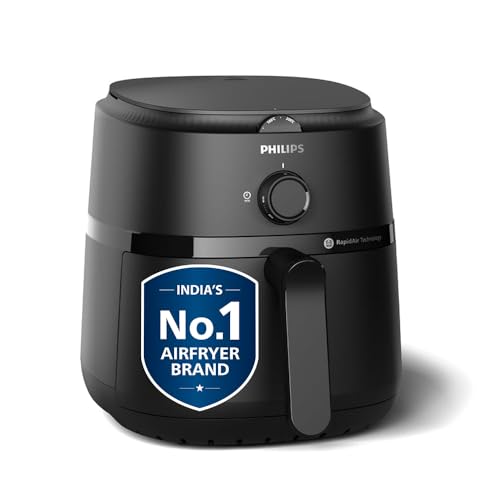
Philips NA120/00 4.2L Air Fryer, 1500W
Most families of 2-4: the best-selling air fryer in India
Frequently Asked Questions
How do I remove burnt masala smell from my air fryer?
A persistent burnt masala smell after cleaning is almost always coming from the heating element — the area most people miss. To remove it: (1) Clean the heating element using the toothbrush + baking soda paste method described above. (2) After cleaning, fill the basket with a mixture of water + 2 tablespoons of white vinegar (or lemon juice) and run the air fryer at 200°C for 5 minutes — the steam will help deodorise the interior. (3) Let it cool completely, wipe dry, and run empty at 180°C for another 3 minutes to burn off any remaining moisture. If the smell persists, the heating element coating has absorbed the odour permanently — it may gradually reduce with continued use.
Is it safe if the non-stick coating of my air fryer basket is scratching off?
This depends on the coating type. PTFE (Teflon-based) coatings: Small amounts of ingested PTFE particles are generally considered inert and pass through the body without absorption, according to most food safety authorities. However, if you see significant flaking (large visible pieces coming off), it's time to replace the basket or the entire unit — both for safety peace of mind and because a degraded coating will cause food to stick badly. Ceramic coatings: Generally safer when degraded but will cause significant sticking. Replace the basket. To prevent this: never use metal utensils, avoid abrasive scrubbing, and don't run the air fryer at temperatures above 220°C with an empty basket.
Can I use soap to clean the inside of the air fryer (the main unit, not the basket)?
For the main unit (where the fan and heating element are), use only a slightly damp cloth with no soap. Soap residue on the heating element creates smoke and fumes when heated. A damp cloth + baking soda paste for any spot cleaning is the safe approach. Never pour water into the main unit or hold it under a running tap — only the removable basket and drawer components should ever contact water.
How do I prevent turmeric from staining my air fryer basket permanently?
Prevention is significantly easier than removal. The three best preventive measures: (1) Line with parchment or silicone liner for any recipe using turmeric — the liner takes the stain, not the basket. (2) Clean within 10 minutes of cooking while the basket is still warm — turmeric pigment bonds much less aggressively to warm (not yet fully cooled and hardened) surfaces. (3) Lightly spray the basket with oil before cooking — a thin oil layer creates a barrier between the turmeric marinade and the coating surface, reducing direct pigment contact. For already-stained baskets, the lemon + salt method described above is the most effective home remedy.
Always check your air fryer's manual first — cleaning advice varies by brand and coating type, and what's safe for one non-stick coating may not be for another.
Looking for an air fryer that's easy to clean and ideal for Indian cooking? Read our Best Air Fryer in India 2026 guide for our recommendations.
Related Reading
- 10 Indian Snacks in Air Fryer — Exact Cook Times — What to cook in it
- Air Fryer Chicken Recipes India — After cooking, clean using this guide
- Air Fryer for Weight Loss India — Switching from deep frying