Disclosure: This post contains affiliate links. If you buy through our links, we earn a small commission at no extra cost to you. Read our affiliate policy.
Walk into any electronics store or scroll through Amazon India, and mixer grinders are marketed at every wattage from 500W to 1200W. Each claims to be "powerful enough for all Indian cooking." None of them explain the actual difference in real kitchen performance.
This guide does exactly that. We break down what each wattage level can and can't do — with specific Indian cooking tasks as benchmarks.
The Honest Answer First
| Household Type | Recommended Wattage | Why |
|---|---|---|
| Bachelor / couple (minimal cooking) | 500W | Sufficient for chutneys + basic tasks |
| Family of 4 (standard Indian cooking) | 750W | Handles all daily tasks reliably |
| Family grinding dosa batter weekly | 900W | Sustained wet grinding without overheating |
| Joint family / heavy daily grinding | 1000W | Maximum capacity, longest motor life |
For most Indian households: 750W is the sweet spot. It handles everything except very heavy sustained wet grinding. It's the minimum we recommend for anyone cooking Indian food daily.
500W Mixer Grinder — When Is It Enough?
What 500W handles well:
- ✅ Mint chutney, coriander chutney
- ✅ Milkshakes, lassi, smoothies
- ✅ Small quantities of soft spices (cumin powder, coriander powder)
- ✅ Ginger-garlic paste (small quantity)
- ✅ Tomato puree
What 500W struggles with:
- ❌ Hard dry spices (turmeric, dried red chillies in large quantities)
- ❌ Dosa batter or idli batter
- ❌ Coconut grinding
- ❌ Large batch grinding (200g+ dry spices at once)
- ❌ Continuous operation for more than 5–6 minutes
The problem with 500W: When you try to grind hard spices or wet batter, the motor slows under load. If you keep pushing it, the motor heats up. Without proper overload protection, this leads to premature motor failure within 2–3 years of daily Indian cooking use.
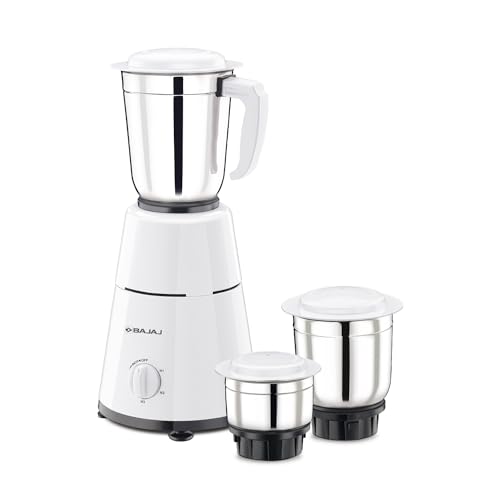
Best 500W option:
The Bajaj GX-1 500W is the most reliable 500W mixer on the market — Bajaj's service network and honest 500W rating make it the safest budget buy. But our honest advice: if you cook Indian food daily, spend a little more and get a 750W.
750W Mixer Grinder — The Indian Kitchen Sweet Spot
What 750W handles well:
- ✅ All chutneys — coconut, mint, tomato
- ✅ Dry spice grinding — turmeric, chilli, cumin, coriander
- ✅ Ginger-garlic paste in bulk
- ✅ Dosa batter / idli batter (for 2–4 people, with grinding in batches)
- ✅ Coconut milk paste
- ✅ Purees, soups
- ✅ Daily household use for family of 4
Where 750W has limits:
- ⚠️ Very heavy batter grinding (500g+ ingredients) — needs batching
- ⚠️ Continuous operation beyond 10–12 minutes
- ⚠️ Very hard dried ingredients (whole black pepper, star anise)
Our 750W recommendations:
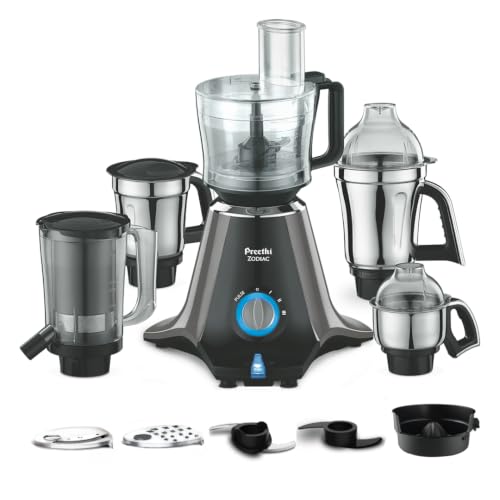
Preethi Zodiac MG-218 — Best 750W all-rounder with Philips service network.
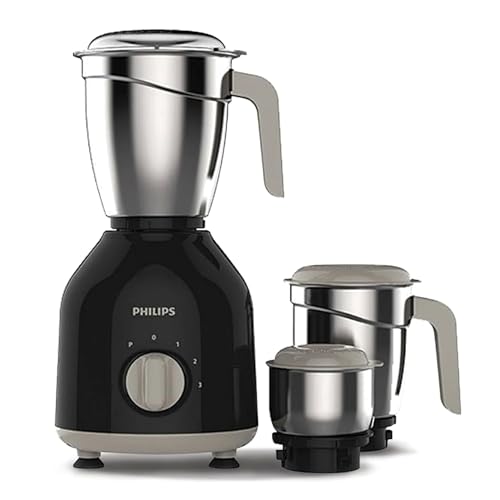
Philips HL7756 — Best 750W for households wanting brand reliability + SmartCare service.
Prestige Iris 750W — Best 750W budget option with Prestige's extensive service network.
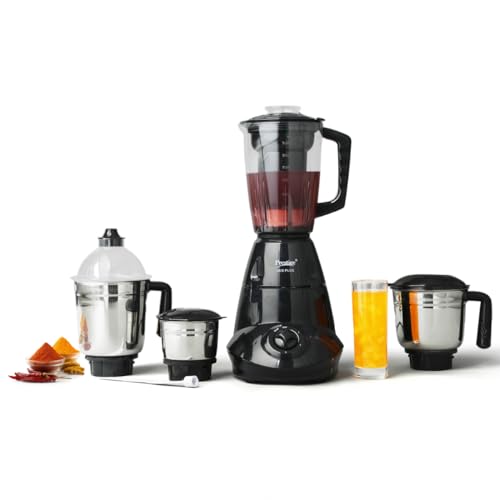
Prestige Iris 750W
✅ Budget families wanting 4 jars with Prestige's pan-India service coverage
Butterfly Jet Elite — Best 750W for South Indian cooking, particularly coconut and wet grinding.
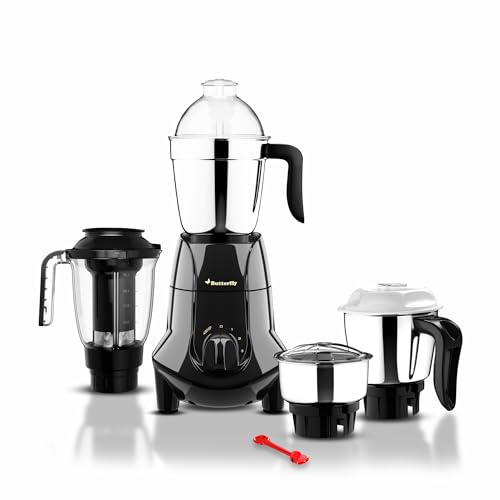
Butterfly Jet Elite 750W
✅ South Indian families who make idli/dosa batter and coconut-based dishes daily
900W Mixer Grinder — For Serious Wet Grinding
Where 900W makes a real difference:
- ✅ Daily dosa / idli batter grinding without batching
- ✅ Large batch dry spice grinding (200–300g at once)
- ✅ Extended continuous operation (15–20 minutes)
- ✅ Very hard spices without motor strain
- ✅ Better long-term motor life under heavy use
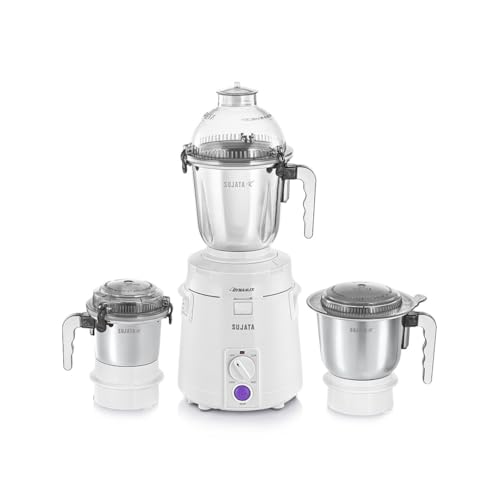
The 900W recommendation: Sujata Dynamix
No other 900W mixer grinder at this price handles sustained Indian cooking loads as reliably as the Sujata Dynamix. The motor runs at genuine 900W under load. The flow-breaker jar design maximises wet grinding efficiency.
1000W Mixer Grinder — Maximum Power
Who genuinely needs 1000W:
- Joint family of 8+ grinding batter daily
- Households making large batches of masala paste for the week
- Anyone who wants the longest possible motor life under heavy daily use
- Semi-commercial use (small tiffin service, etc.)
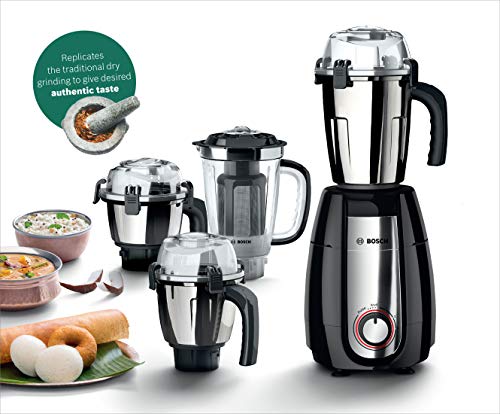
1000W recommendation: Bosch TrueMixx Pro
The Bosch TrueMixx Pro 1000W is the best overall mixer grinder in India. European motor engineering delivers genuine 1000W under load. ProBlend6 jar design is optimised for Indian grinding tasks. 5-year comprehensive warranty backs the quality claim.
Also consider: Sujata MG03 1000W — Sujata's professional-grade model for heavy daily use.
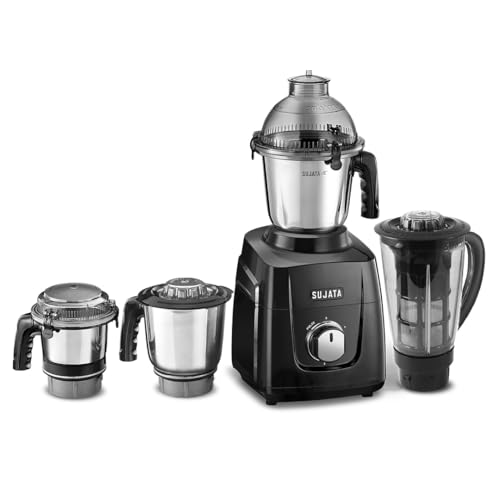
Sujata MG03 1000W
✅ Large families (6+) and serious cooks who need maximum power for large-batch, heavy-duty daily grinding
The BLDC Alternative: Atomberg Zenova 550W
The Atomberg Zenova uses a Brushless DC (BLDC) motor — fundamentally different technology from standard mixer grinders. The BLDC motor:
- Runs 40–50% quieter than standard motors
- Consumes less electricity for equivalent output
- Has a longer theoretical motor lifespan (no brush wear)
- Includes intelligent speed control
At 550W rated power, the Atomberg Zenova handles standard Indian cooking tasks including moderate wet grinding. Not the choice for daily heavy batter grinding, but the clear winner for households where noise is a concern.
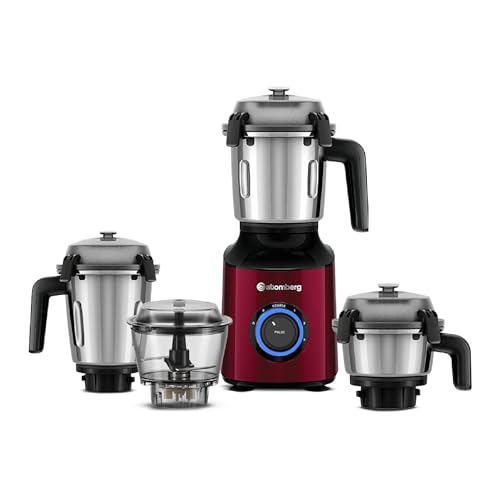
Atomberg Zenova BLDC 550W
✅ Tech-forward, eco-conscious buyers who want premium design and lowest running cost
📊 Complete Wattage Decision Guide
| I mainly cook... | Get... | Our Pick |
|---|---|---|
| Basic chutneys, milkshakes | 500W | Bajaj GX-1 |
| All Indian cooking for 4 | 750W | Preethi Zodiac |
| Dosa batter 3x/week | 900W | Sujata Dynamix |
| Heavy daily grinding | 1000W | Bosch TrueMixx Pro |
| Quiet operation priority | BLDC 550W | Atomberg Zenova |
📊 Real-World Performance: 500W vs 750W vs 900W vs 1000W
Marketing wattage and real-world performance are not the same. Here's what each power level actually delivers in a standard Indian kitchen:
| Task | 500W | 750W | 900W | 1000W |
|---|---|---|---|---|
| Coconut chutney (100g) | ✅ Fine | ✅ Fine | ✅ Fine | ✅ Fine |
| Dry spices — cumin, coriander (50g) | ✅ Fine | ✅ Fine | ✅ Fine | ✅ Fine |
| Dry spices — turmeric whole, red chilli (100g) | ⚠️ Slow, heats | ✅ Handles | ✅ Effortless | ✅ Effortless |
| Ginger-garlic paste (200g) | ⚠️ Sluggish | ✅ Fine | ✅ Fine | ✅ Fine |
| Dosa batter (500g ingredients) | ❌ Overheats | ⚠️ Needs batching | ✅ Single batch | ✅ Single batch |
| Dosa batter (1kg+ ingredients) | ❌ Not suitable | ❌ Too much load | ⚠️ Batching advised | ✅ Handles |
| Continuous operation (20+ min) | ❌ Trips overload | ⚠️ Risky | ✅ With breaks | ✅ Handles |
| Noise level | Moderate | Moderate-high | High | High |
| Typical electricity cost/month (daily use) | Low | Medium | Medium-High | High |
Key takeaway: The jump from 500W to 750W is significant. The jump from 750W to 900W matters only if you grind dosa batter regularly. Beyond 900W, the gains are marginal for household use.
How to Test if Your Mixer Grinder Is Delivering Rated Wattage
Most people never verify if their mixer grinder actually runs at its rated wattage. Here's how you can test it practically:
Method 1: The Load Test
Grind 200g of dried whole turmeric in the dry grinding jar. A genuine 750W motor should complete this task in 90–120 seconds without the motor slowing perceptibly. If the motor audibly slows or the body becomes hot to touch within 60 seconds, the motor is not delivering rated wattage under load.
Method 2: Timed Dosa Batter Test
For a 500g batch (250g urad dal + 250g rice, soaked), a genuine 750W motor should produce smooth batter in 12–15 minutes of grinding in 3–4 minute batches. If you're still getting coarse batter after 20 minutes, the motor is underperforming.
Method 3: Electricity Monitor
A plug-in smart meter (available on Amazon India) lets you measure actual power draw. If a "750W" mixer draws only 400–450W under full load, you have an underpowered motor — a common issue with cheap mixer grinders.
What to do if your mixer is underperforming:
- Under warranty: Contact the brand's service centre immediately — this is a manufacturing defect
- Out of warranty: Consider upgrading. A mixer running at 60% of rated power won't recover with servicing
Wattage vs Price: Is Higher Wattage Always Better Value?
Higher wattage costs more in two ways: upfront price and electricity bills. Is the premium justified?
500W to 750W: Worth Every Rupee
For Indian cooking, this upgrade is almost always justified. The price difference between a 500W and 750W model from the same brand is usually small. The performance difference for spice grinding and wet grinding is substantial. Always upgrade from 500W to 750W.
750W to 900W: Worth It If You Grind Batter
If you grind dosa or idli batter 2+ times per week, the 900W motor's sustained load capacity adds meaningful value — it reduces motor stress, extends lifespan, and produces smoother batter. If you rarely grind batter, the extra cost doesn't make a noticeable difference.
Electricity cost difference: A 900W mixer running 30 minutes daily costs slightly more per month than a 750W model. Over a year, that's negligible against the purchase price.
900W to 1000W: For Heavy Users Only
For a standard nuclear family, the 900W to 1000W jump delivers minimal practical improvement. The only clear beneficiaries are joint families (8+ members), households grinding batter daily for 6+ people, or anyone doing semi-commercial work.
Value Summary:
| Upgrade | Typical Price Jump | Worth It If... |
|---|---|---|
| 500W → 750W | Small | Always |
| 750W → 900W | Moderate | Grind batter 2x+/week |
| 900W → 1000W | Significant | Joint family or semi-commercial use |
| Standard → BLDC | Premium | Noise-sensitive household |
❓ Frequently Asked Questions
Is 750W enough for mixer grinder in India? Yes — for most Indian households cooking daily. 750W handles all chutneys, dry spices, ginger-garlic paste, and moderate dosa batter grinding. Only upgrade to 900W if you grind batter daily for 4+ people.
Is more wattage always better? Not necessarily. Higher wattage = higher electricity consumption and more noise. 1000W for light household use is overkill. Match wattage to actual cooking needs.
Does higher wattage mean better grinding? Higher wattage enables better grinding under load — the motor doesn't slow down when it hits resistance. But jar design and blade quality also matter significantly. A 1000W mixer with poor jar design can grind worse than a well-designed 750W.
Which is better — 750W or 1000W for home use? For a standard family of 4: 750W is sufficient and economical. For joint families with heavy daily grinding: 1000W justifies the extra cost through longer motor life and better performance.
All prices verified on Amazon India as of June 2026. See our complete mixer grinder guide for model-by-model comparisons.
- Best Mixer Grinder in India 2026 — Top 5 picks, all 13 models compared