Disclosure: This post contains affiliate links. If you buy through our links, we earn a small commission at no extra cost to you. Read our affiliate policy.
Dishwashers have transitioned from a luxury to an absolute necessity in many Indian kitchens, taking the hassle out of scrubbing oily kadhais, sticky pressure cookers, and endless plates. IFB is one of the leading brands in India, known for adapting their appliances to handle heavy Indian masalas and tough stains. However, like any advanced appliance, your IFB dishwasher relies on a complex system of sensors, pumps, and heaters.
When something goes wrong, the machine communicates through error codes. Seeing E1, E4, or E8 flashing on the digital display can be incredibly frustrating, especially when you have a mountain of dirty dishes waiting.
But don't call the service center just yet! Most of these errors are caused by external factors—like water pressure, hard water, or simple blockages—that you can resolve yourself. In this comprehensive guide, we will break down exactly what E1, E4, and E8 mean, how to fix them step-by-step, and when it’s finally time to call in the professionals.
Quick Summary: The Panic-Free Answer
Need your dishwasher running right now? Here is the rapid-fire breakdown of the codes:
- Error E1: The dishwasher is not getting water. Check if your inlet tap is turned on, ensure your overhead tank has water, and clean the mesh filter in the water inlet hose.
- Error E4: The machine has detected a leak or overflow in the bottom base pan. This is often caused by using the wrong detergent (which creates too many suds) or a tilted machine. Unplug, tilt slightly to drain the pan, and restart.
- Error E8: The water isn't heating. In India, this is usually caused by hard water scaling coating the heating element. You need to run a descaling cycle, though severe cases may require a new heater.
Keep reading for detailed, step-by-step instructions on resolving these issues safely at home.
Understanding IFB Error Code E1: Water Inlet Issue
What Does E1 Mean?
Error E1 is triggered when the dishwasher’s flow meter does not detect a sufficient amount of water entering the tub within a specific time limit. The machine pauses the cycle to prevent the internal wash pump from running dry, which would burn out the motor.
Likely Causes in India
- Tap is Closed: The most common and embarrassing cause. Someone simply turned off the water valve connected to the dishwasher.
- Low Water Pressure: If you live in a high-rise apartment or rely on an overhead tank that is nearly empty, the water pressure might fall below the required threshold (usually 0.03 - 1.0 MPa).
- Kinked Inlet Hose: The pipe connecting the tap to the machine is bent, squashed behind the machine, or twisted.
- Clogged Inlet Filter: Indian municipal and borewell water often carries fine sand, silt, and debris. This clogs the tiny mesh filter located at the point where the hose connects to the machine.
Step-by-Step DIY Fix for Error E1
- Check the Basics: Ensure the water tap is fully turned on. Go to your kitchen sink and check the water pressure. If the pressure is unusually low everywhere in the house, you need to wait for the municipal supply or tank to fill up.
- Inspect the Hose: Pull the dishwasher out slightly. Ensure the thick grey or blue water inlet hose is not squashed against the wall or kinked in half.
- Clean the Inlet Filter:
- Turn off the water tap.
- Unscrew the inlet hose from the back of the dishwasher (or from the tap end, depending on the model). Have a towel ready for a small spill.
- Inside the connection point, you will see a small plastic mesh filter. Pull it out gently with a pair of pliers.
- Scrub the mesh under running water using an old toothbrush to remove rust, sand, and calcium deposits.
- Put the filter back, reconnect the hose tightly, turn on the water, and start a new cycle.
Understanding IFB Error Code E4: Overflow or Leak Detected
What Does E4 Mean?
E4 is a critical safety intervention. Underneath the visible washing tub, there is a hidden base pan with a float switch (usually a piece of styrofoam on a microswitch). If water leaks from the tub, hoses, or pumps, it collects in this base pan. The float rises, triggers the switch, forces the machine to stop, and activates the drain pump to prevent flooding your kitchen floor.
Likely Causes
- Excessive Suds (Foam): This is the #1 cause of E4. If you accidentally use regular dishwashing liquid (like Vim or Pril gel) instead of specialized dishwasher detergent, it creates a massive foam bomb inside the machine. The foam expands, leaks out of the vents, and enters the base pan.
- Blocked Drain: If the main filter inside the tub is clogged with food chunks, water level rises too high and overflows.
- Faulty Door Seal: The rubber gasket around the door might be torn or coated in food grime, allowing water to escape during the high-pressure wash.
- Internal Plumbing Leak: A loose hose or cracked pump housing inside the machine.
Step-by-Step DIY Fix for Error E4
[!CAUTION] Because E4 involves water pooling near electrical components, completely unplug the machine from the wall socket before proceeding.
- Check for Suds: Open the door. Is it full of bubbles? If yes, scoop out as much foam as possible. Pour half a cup of cooking oil into the bottom—oil breaks down suds instantly. Close the door and let it sit for a few hours.
- Drain the Base Pan:
- Pull the machine out from under the counter.
- Place a large towel on the floor.
- Carefully tilt the dishwasher backward at a 45-degree angle. You will see water pouring out from the bottom base.
- Once the water stops dripping, set the machine upright.
- Clean the Internal Filters: Open the door, remove the bottom rack, twist and lift out the cylindrical filter assembly. Clean it thoroughly under the tap to ensure water can drain properly.
- Dry and Restart: Leave the machine unplugged with the door open for 24 hours to let the internal base dry completely. Plug it back in and run a test cycle. If E4 returns immediately, you have a physical leak that requires a technician.
Understanding IFB Error Code E8: Heating Element Failure
What Does E8 Mean?
Error E8 indicates that the dishwasher is failing to heat the water. Dishwashers rely on hot water (often 65°C to 70°C) to dissolve detergent, melt grease, and sanitize dishes. If the temperature sensor does not register a heat increase within a certain timeframe, the cycle halts.
The Indian Context: Hard Water Scaling
In India, the water supply in many cities is notoriously "hard," meaning it is packed with dissolved calcium and magnesium. When hard water is heated, these minerals precipitate out and form a thick, white, chalky crust on the heating element. Over time, this crust acts as an insulator. The heater has to work twice as hard to heat the water, eventually overheating and burning out.
Prevention and Fixes for Error E8
Unlike E1 and E4, E8 usually indicates a hardware failure that requires replacement. However, you can prevent it and sometimes resolve minor sensor glitches.
- Use IFB Auto Dish Descaler: If the machine still heats slightly but throws E8 occasionally, it might be heavily scaled. Run an empty machine on the hottest cycle with a packet of IFB Auto Dish Descaler or a cup of white vinegar to dissolve the limescale.
- Check Salt Levels: Your dishwasher has an inbuilt water softener. Ensure you are regularly topping up the Dishwasher Salt compartment and that the hardness setting matches your local water supply.
- Hardware Failure: If the water remains ice-cold during the wash, the heating element (which is often integrated with the wash pump in modern IFB models) is completely dead.
When to Call a Technician (And Expected Costs in India)
If you have tried the DIY steps and the errors persist, it is time to contact IFB Customer Care. Here is a rough estimate of what you might spend on spare parts in India (excluding labor charges, which usually range from ₹400 to ₹600):
- For E1 (Inlet Valve): If the valve solenoid is burnt out and won't open even when clean, a replacement inlet valve costs between ₹1,000 and ₹1,500.
- For E4 (Base Pan Sensor/Pump leak): If the leak is due to a cracked wash pump casing, it can be expensive. Replacing door seals or a simple float switch is cheaper, ranging from ₹800 to ₹1,500.
- For E8 (Heating Element): Because the heater is often built into the main wash pump motor block, replacing it is costly. Expect to pay between ₹3,500 and ₹5,500.
- Main PCB: If the motherboard is fried due to voltage fluctuations, replacements start around ₹4,000 and can go up to ₹7,000.
Time for an Upgrade?
Dishwashers operate in a harsh environment of boiling water, aggressive chemicals, and food debris. If your IFB dishwasher is more than 7 years old, and you are facing a costly E8 heating element failure or repeated E4 leaks, repairing it is likely a bad investment. Older machines also consume significantly more electricity and water.
Consider upgrading to a newer model. IFB's current Neptune FX14 (14 place) is the highest-rated dishwasher we list, at 4.4★ from 514 ratings, and costs about ₹42,800.
👉 Need more room? The IFB Neptune VX15 has 15 place settings, a third cutlery tray, 70°C Hygiene and 65°C Pots & Pans programs for oily kadhais, and an in-built water softener.
Don't let error codes ruin your evening. Bookmark this guide for the next time your dishwasher acts up, and keep your kitchen running smoothly!
Frequently Asked Questions
What does the E1 error mean on an IFB dishwasher?
E1 on an IFB dishwasher indicates a water inlet error — the machine is not receiving water within the expected time. Common causes: (1) the water supply tap is closed or has insufficient pressure; (2) the inlet hose is kinked or blocked; (3) the inlet valve filter is clogged with sediment. Check the water supply first, then inspect the inlet filter at the point where the hose connects to the machine — clean it under running water.
How do I reset an IFB dishwasher showing an error code?
For most IFB dishwasher error codes: (1) Press and hold the Start/Reset button for 5–10 seconds until the programme indicator lights reset; (2) Open the door and close it firmly; (3) If the error persists, turn off the machine at the mains, wait 5 minutes, then restart. For persistent errors that return after reset, contact IFB customer service on 1860-425-5678.
Why is my IFB dishwasher not draining properly?
If your IFB dishwasher has water at the bottom after a cycle, check: (1) the drain filter at the bottom of the tub — it should be cleaned every 2 weeks; (2) the drain hose at the back — ensure it is not kinked and is elevated correctly (the hose should loop up to at least 50cm above the floor); (3) the sink drain connection — if the shared drain pipe is blocked, the dishwasher cannot drain.
How do I contact IFB service for a dishwasher error in India?
Call IFB customer care on 1860-425-5678 (standard call charges apply), or book a service visit on the IFB website (ifbappliances.com). Response times vary by city.
Why does my IFB dishwasher leave white deposits on my dishes?
White film on dishes after washing is caused by hard water limescale. Solutions: (1) Check if the salt reservoir is empty — refill with dishwasher-specific regeneration salt; (2) Increase the water hardness setting in the machine (your manual lists the settings; match it to a TDS or hardness test of your water); (3) Add more rinse aid; (4) Run a descaling cycle. If your TDS is above 500, consider installing an external inline water softener.
Is it worth repairing an IFB dishwasher or should I buy a new one?
If the machine is under 6 years old, repair is almost always worth it. IFB has excellent parts availability and a wide service network. Common repairs and typical costs: inlet valve replacement ₹800–₹1,500; drain pump ₹1,200–₹2,000; control module ₹2,500–₹5,000; door latch ₹500–₹1,000. If the PCB (control board) has failed on a machine over 8 years old, replacement is usually the better financial decision.
Related Reading
- Best Dishwasher in India 2026 — Compare IFB & all top brands
- IFB vs Bosch Dishwasher India — Full comparison
- How to Clean a Dishwasher in India — Maintenance guide
Looking for a New IFB Dishwasher?
IFB Neptune VX15 — Latest Model
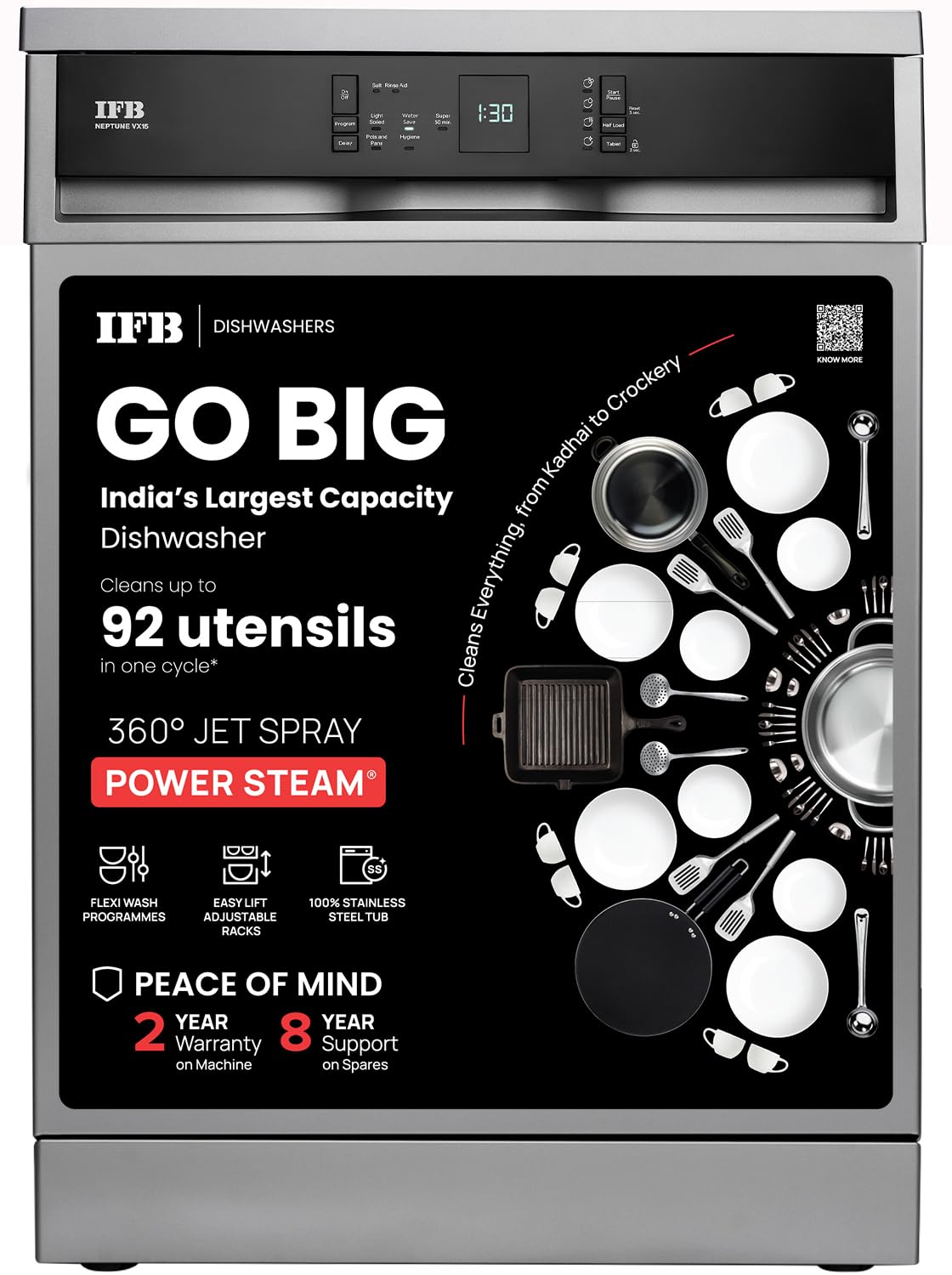
IFB Neptune VX15 15 Place Dishwasher with 3rd Cutlery Tray
Large families wanting 15 place settings and a cutlery tray for less than the 15 place Bosch
IFB Neptune FX14 — Our Best Value
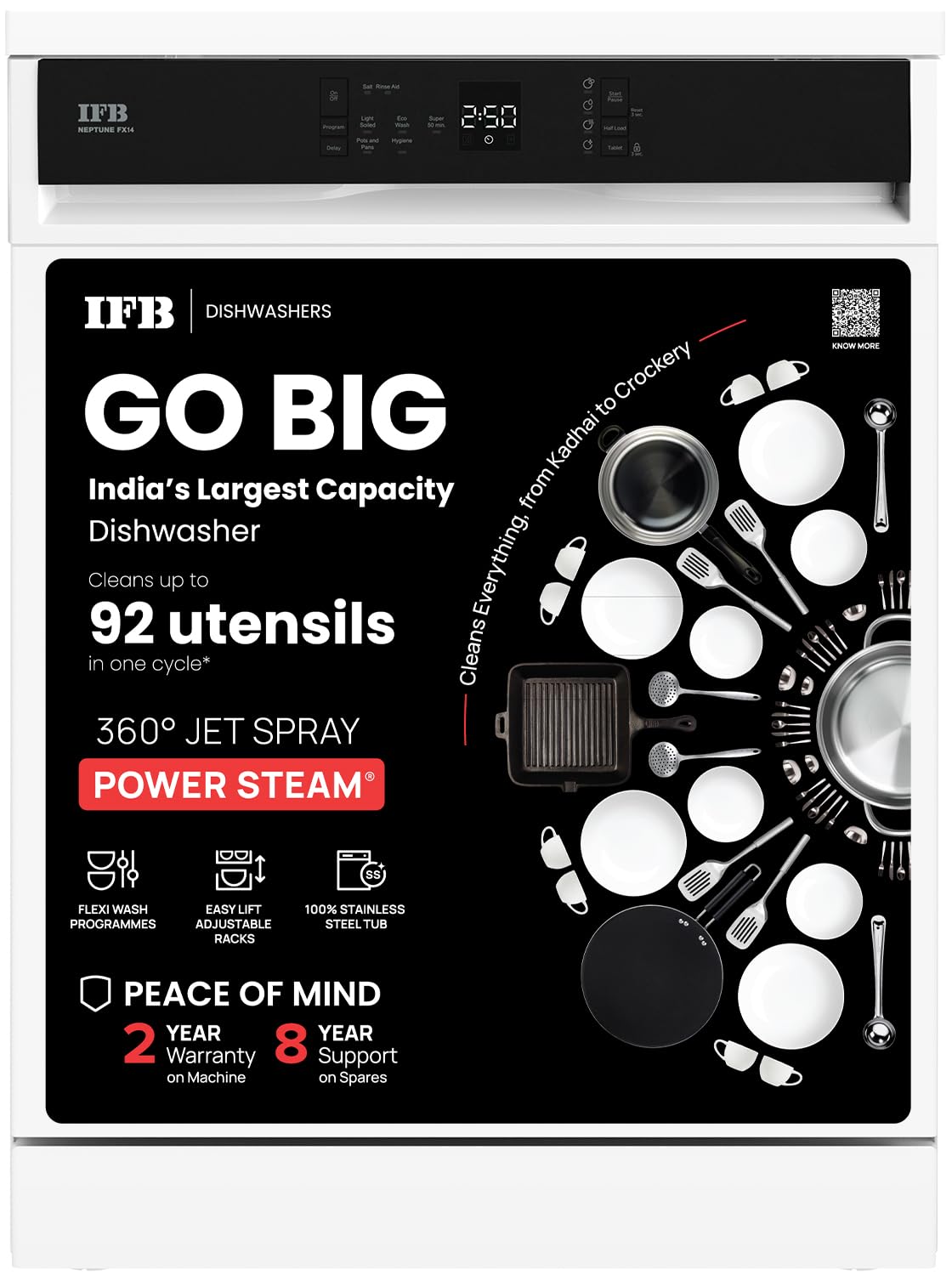
IFB Neptune FX14 14 Place Dishwasher with 70°C Hot Water Wash
Families of 4-6 wanting the highest-rated dishwasher at the lowest price
Compare IFB vs Bosch → IFB vs Bosch Dishwasher India