
Disclosure: This post contains affiliate links. If you buy through our links, we earn a small commission at no extra cost to you. Read our affiliate policy.
If you're hunting for the best air fryer for samosas and pakoras in India, you've landed in the right place. This isn't a generic list copied from a US tech blog — every pick here is judged on what Indian snacks demand, using each model's specs, its Amazon rating and review count, and the brand's service reach in India. (We don't run hands-on lab tests; here's how we score.)
Here's why this matters: samosas and pakoras are significantly harder to air-fry than French fries. The maida casing of a samosa needs even, consistent heat circulation from all sides — a hot spot will scorch one corner while leaving another pale and doughy. Batter-coated pakoras are even trickier because the loose batter can drip, burn on the basket's non-stick surface, and turn rubbery if the temperature isn't high enough. If an air fryer can nail samosas and pakoras, it can handle anything in your Indian kitchen.
Why Samosas and Pakoras Are the Hardest Job for an Air Fryer
Most air fryer reviews focus on frozen fries — the easiest possible food. Fries are forgiving: they're flat, uniform, and need no structure. Samosas, on the other hand, are triangular, thick-walled, and filled with a moist stuffing that releases steam as it heats. That steam needs to escape without making the pastry soggy, and the outer shell needs to turn uniformly golden.
Pakoras present a different challenge: the chickpea batter (besan) is hydrated and sticky. In a deep-fryer, the oil surrounds the pakora from all sides instantly, cooking the batter in seconds. In an air fryer, the hot air needs to set the batter's outer crust before the inside cooks — which is why temperature control and wattage are non-negotiable.
During the Indian monsoon season (June through September), the demand for these chai-time snacks skyrockets — but so does the reluctance to heat up a kadhai full of oil in a humid kitchen. Air fryers become the perfect solution: faster cleanup, less grease splatter on your kitchen walls, and far less oil than deep frying.
What to Look for When Buying an Air Fryer for Indian Snacks
Before we get to the ranked list, here's the buying framework we developed specifically for samosas and pakoras — not for reheating pizza or making chips.
1. Basket Size: Space Is Non-Negotiable
Samosas cannot be stacked. If you overlap them in the basket, the touching surfaces stay pale and soggy while the exposed surfaces overheat. As a rule of thumb:
- 4L basket → fits 6–8 medium samosas in a single layer comfortably.
- 4.5L–5L basket → fits 8–10 samosas, or 2 full batches of pakoras.
- 6L basket → ideal for large families or when making chai-time snacks for guests.
For a family of 4 in a city like Pune or Indore, a 4–4.5L basket is the sweet spot. For joint families of 6+ in cities like Lucknow or Patna — where samosa-making is a serious affair — go for 6L.
2. Wattage: Minimum 1200W for Crispy Results
This is the most commonly ignored spec and the most important one. Lower-wattage machines (1000W or below) take too long to reach temperature and lose heat every time you open the basket. The result? Pakoras that are chewy on the outside and undercooked inside.
Our firm recommendation: minimum 1200W. 1400W+ is better.
An important note for buyers in cities with voltage fluctuations (common in Tier-2/3 cities like Nagpur, Kanpur, Bhopal): check that the air fryer has a rated voltage range of 220–240V and ideally has an overload protection circuit. Most Indian-brand models specify this; some imported models do not.
3. Preset Modes: The 'Snacks' or 'Fry' Preset
A dedicated snacks preset typically defaults to 180–190°C, which is exactly the range you need for samosas and pakoras. While manual control works fine, a preset reduces guesswork — especially for first-time users. Look for a "Snacks" or "Fry" button.
4. Non-Stick PFOA-Free Coating
Batter drips from pakoras will land on the basket's non-stick surface. You need a coating that releases food easily without scratching and doesn't leach chemicals at high heat. Check for a PFOA-free coating, given the high temperatures (190–200°C) used for Indian snacks. If you want to avoid PTFE non-stick entirely, the NUUK BRĪSK below has a ceramic basket.
How We Ranked Them
Each model is ranked by its Indian Kitchen Score™ with snacks in mind: basket space for a single layer, wattage (heat recovery after you open the drawer), temperature range, presets, and after-sales service in India. We also weigh each model's Amazon rating against how many buyers left it — a 4.4★ from a thousand buyers tells you more than a 4.4★ from a hundred. Every pick is rated 4★ or higher with at least 100 reviews and at least 100 bought in the past month.
Ranked: Best Air Fryers for Samosas and Pakoras in India (2026)
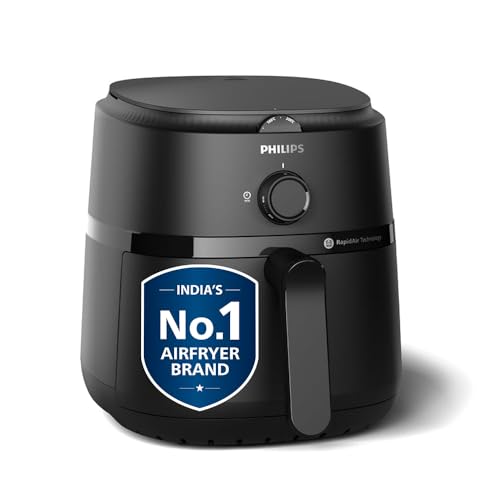
1. Philips NA120/00 4.2L — Best Overall
Capacity: 4.2L | Wattage: 1500W | Rating: 4.3★ from 6,194 reviews
Best Overall
Score 90/100 · ★ 4.3 (6,194)
Most families of 2-4: the best-selling air fryer in India
₹4,699₹5,99522% off
Amazon India's best-selling air fryer (9,000+ bought in September 2026). Philips Rapid Air with the starfish-patterned pan circulates hot air evenly around food, which is what a thick-walled samosa needs, and 1500W recovers heat quickly after you open the drawer.
Pros:
- Rapid Air with the starfish pan for even browning
- 12 cooking modes; 80–200°C
- Dishwasher-safe basket
Cons:
- 4.2L is tight for families of 5+
- No window to watch browning
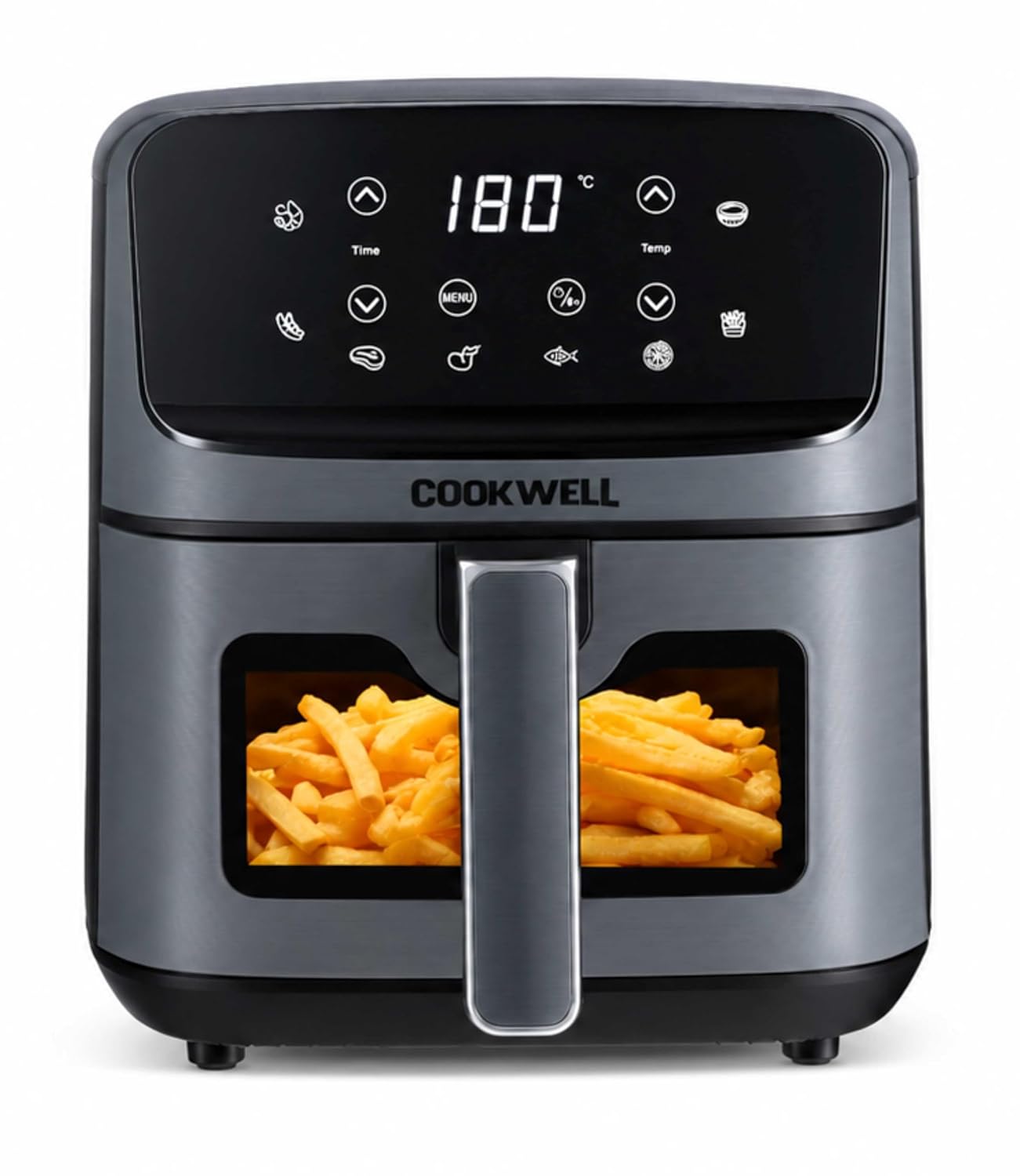
2. Cookwell 5L — Best Budget Pick
Capacity: 5L | Wattage: 1400W | Rating: 4.3★ from 1,594 reviews
Budget Pick
Score 85/100 · ★ 4.3 (1,594)
Families of 3-4 wanting a big basket with a window for the least money
₹3,199₹9,00064% off
A bigger 5L basket than the Philips, plus a window to watch samosas brown, for about ₹3,400. Selling 900+ a month.
Pros:
- 5L basket fits more samosas in one layer
- See-through window
- About ₹3,400
Cons:
- The listing gives no temperature range or preset count
- Basket is not dishwasher-safe
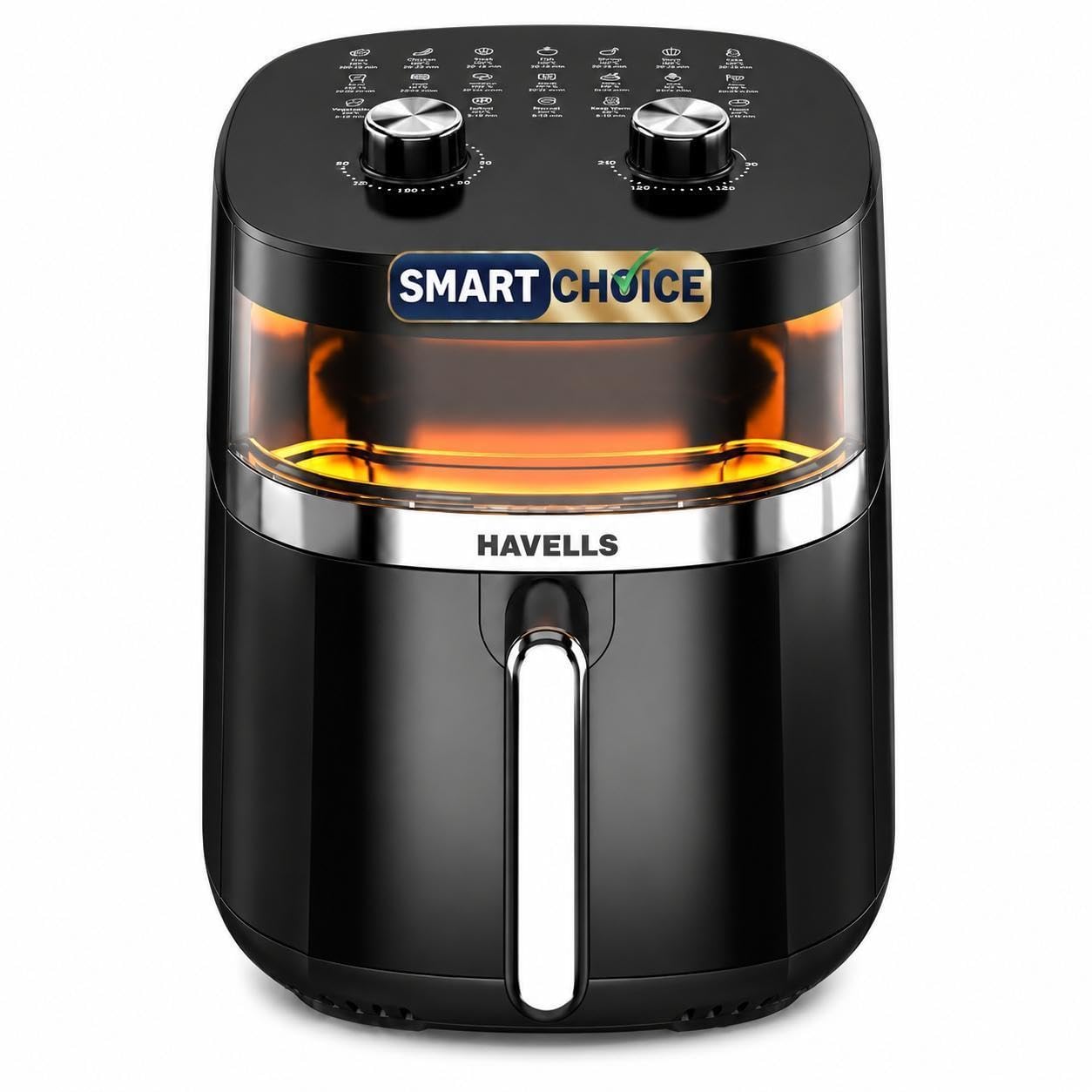
3. Havells Prolife Stellar Chef 5.5L — Best With a Window
Capacity: 5.5L | Wattage: 1500W | Rating: 4.3★ from 287 reviews
Score 85/100 · ★ 4.3 (287)
Families of 4-5 wanting a big basket with a window from a brand with wide service
₹5,690₹6,89517% off
A 5.5L basket with a window, 8 presets, 80–200°C and a 2-year warranty, selling 500+ a month at about ₹5,400. The window lets you watch the batter on pakoras set without opening the drawer.
Pros:
- 5.5L for bigger batches
- Window and 8 presets
- 2-year warranty
Cons:
- Under 300 ratings
- Basket is not dishwasher-safe
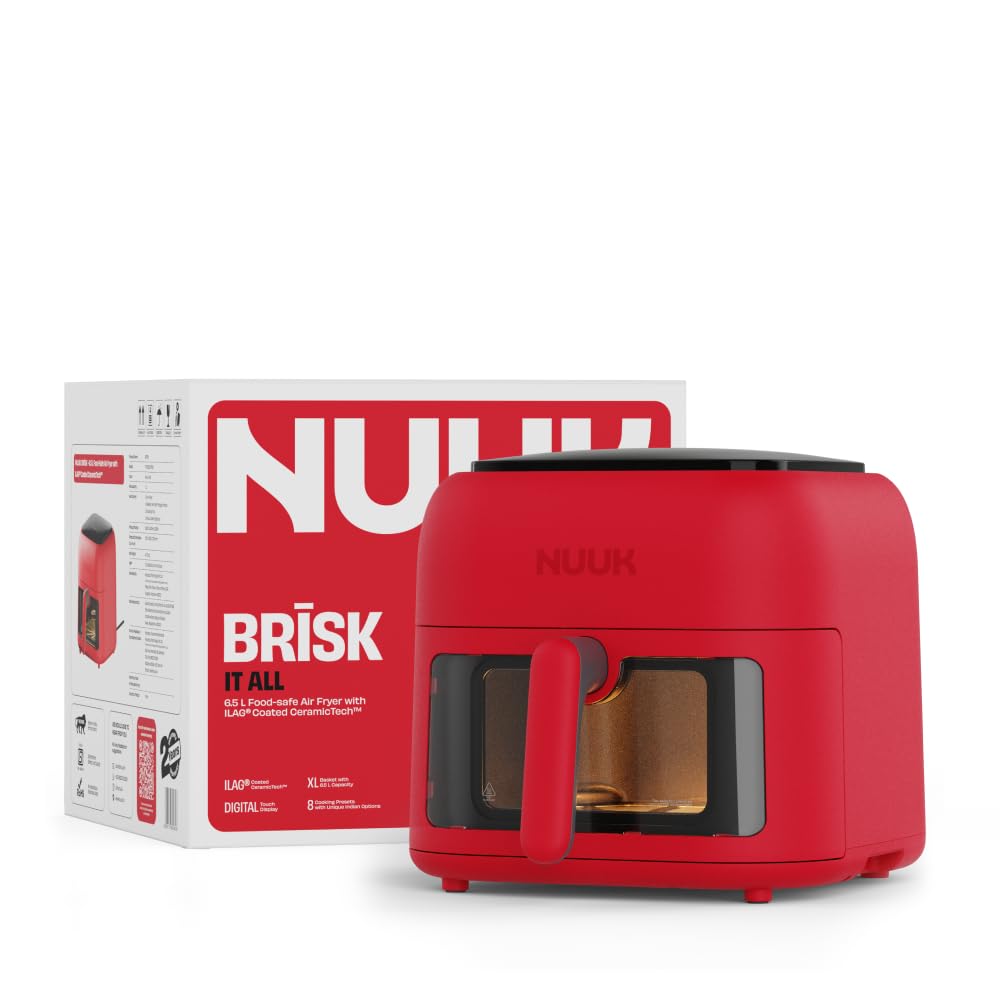
4. NUUK BRĪSK 6.5L — Best for Indian Presets
Capacity: 6.5L | Wattage: 1600W | Rating: 4.5★ from 389 reviews
Score 85/100 · ★ 4.5 (389)
Families of 4-5 wanting a large ceramic, PTFE-free basket
₹7,499₹8,49912% off
One of the few air fryers with presets for Indian snacks (samosa, kebab, roti and tikka), a 6.5L ceramic basket free of PTFE, PFAS and PFOA, and 300+ sales a month, at about ₹8,500.
Pros:
- Samosa and tikka presets
- Large 6.5L ceramic basket
- 4.5★
Cons:
- About ₹8,500
- Basket is not dishwasher-safe
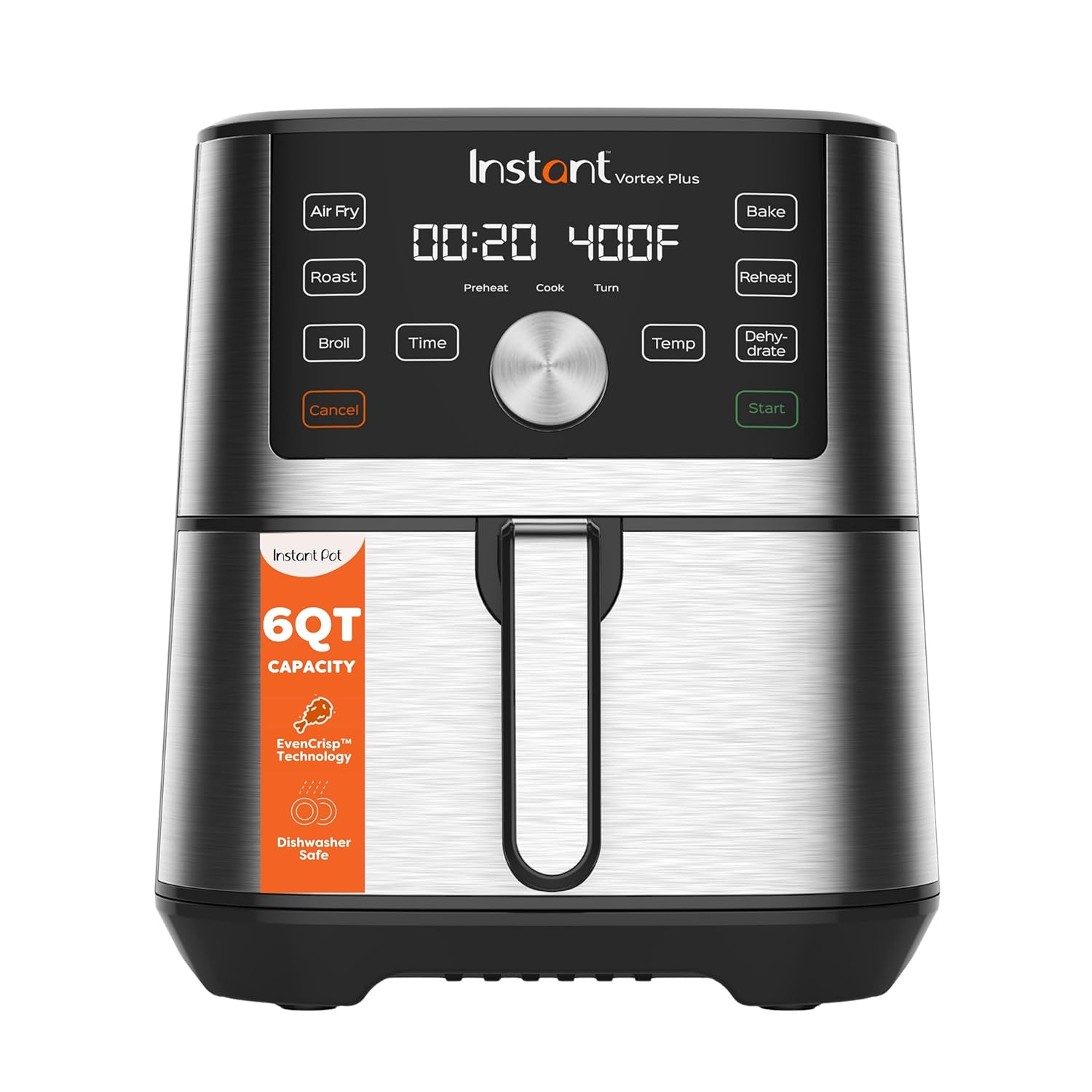
5. Instant Vortex Plus 6L — Best for Large Families
Capacity: 6L (5.7L basket) | Wattage: 1500W | Rating: 4.8★ from 21,428 reviews
Premium Pick
Score 92/100 · ★ 4.8 (21,428)
Families of 4-5 wanting the highest-rated air fryer we list
₹9,999₹20,99952% off
For samosas for 8–10 people, the big basket means fewer batches. It is the highest-rated air fryer we list, with a stainless steel body and six functions including dehydrate.
Pros:
- Large basket, fewer batches
- 4.8★ from over 21,000 ratings
- Dishwasher-safe basket
Cons:
- About ₹12,000
- 1-year warranty
Indian Snack Performance Guide: Temperature and Timing Cheat Sheet
Starting points for common snacks — every model heats a little differently, so check the first batch and adjust.
Samosa (Frozen or Homemade)
- Temperature: 180–185°C
- Time: 12–15 minutes (fresh homemade) / 14–16 minutes (frozen)
- Shake: At the 7-minute mark
- Oil: Lightly brush the outer casing with oil before cooking
- Pro tip: If using homemade samosas that are refrigerator-cold, add 2 minutes to the cook time. Never cook from frozen without brushing with oil — the casing will dry out before the filling heats through.
Pakora (Besan Batter — Onion, Paneer, Mirchi)
- Temperature: 190°C
- Time: 10–12 minutes
- Method: Single layer only, with at least 1cm gap between pieces
- Oil: 1 teaspoon of oil mixed into the batter itself is sufficient; do not brush the basket
- Pro tip: Let pakoras rest for 2 minutes after cooking — they crisp up further as the steam escapes. Don't cover them (they'll go soggy).
Aloo Tikki
- Temperature: 190°C
- Time: 15 minutes
- Flip: At the 8-minute mark (mandatory — the bottom crust is the best part)
- Oil: Brush both sides before cooking
- Pro tip: Press the tikkis slightly flatter than you would for deep frying — a thinner tikki crisps more evenly in an air fryer.
Bread Roll (Stuffed with Aloo)
- Temperature: 200°C
- Time: 8–10 minutes
- Method: Single layer, seam-side down
- Oil: Light brush with oil (or cooking spray)
- Pro tip: Day-old bread rolls crisp up better than fresh ones. If using fresh bread, toast lightly before stuffing.
The Monsoon Snack Section: Why Air Fryers Were Made for Indian Rainy Season
If you live in Mumbai, Chennai, Kolkata, or any coastal Indian city, you know the monsoon kitchen problem: a deep-frying kadhai on the gas stove heats up the kitchen, adds humidity to an already-humid room, and leaves the exhaust fan running for 30 minutes after you're done. Add oil splatter on the kitchen tiles, and chai-time snacking becomes a full cleaning operation.
An air fryer changes the equation entirely. During peak monsoon (July–August), here's what changes:
- No kadhai heat → your kitchen stays cooler
- No oil splatter → tiles and walls stay clean
- Far less oil → a bottle of refined oil lasts much longer
- Quick cleanup → basket soaks in warm soapy water for 5 minutes, done
- Safe for kids → no open flame, no boiling oil to worry about
For families with school-going children who come home during monsoon lunch breaks craving pakoras, an air fryer means a quick 12-minute batch with no supervision risk. Just load, set, and wait.
Monsoon maintenance tip: In cities with high humidity (Kochi, Goa, Kolkata), wipe the interior of the air fryer dry after every use and store with the basket slightly open to prevent moisture buildup. This extends the life of the non-stick coating.
Quick Comparison Table
| Model | Price | Capacity | Wattage | Best For |
|---|---|---|---|---|
| Philips NA120/00 | About ₹4,850 | 4.2L | 1500W | Best overall |
| Cookwell 5L | About ₹3,400 | 5L | 1400W | Best budget |
| Havells Stellar Chef | About ₹5,400 | 5.5L | 1500W | Window, bigger batches |
| NUUK BRĪSK | About ₹8,500 | 6.5L | 1600W | Indian presets, ceramic |
| Instant Vortex Plus | About ₹12,000 | 6L | 1500W | Large families |
Our Verdict
For most Indian households, the Philips NA120/00 is the right answer: Amazon's best-selling air fryer, with even Rapid Air circulation. If budget is the priority, the Cookwell 5L gives you a bigger basket and a window for less. For large families, the Instant Vortex Plus 6L or NUUK BRĪSK 6.5L.
Also explore our related guides:
Best Overall
Score 90/100 · ★ 4.3 (6,194)
Most families of 2-4: the best-selling air fryer in India
₹4,699₹5,99522% off
Frequently Asked Questions
Q1: Can I make batter-coated pakoras in an air fryer?
Yes, but with important technique adjustments. Thick, dry-ish batter works best — think the consistency of a heaped drop, not a dripping liquid. If your besan batter is too runny, it will drip through the basket mesh and burn on the heating element below. Add 1–2 tablespoons of extra besan to thicken the batter, mix in 1 teaspoon of oil, and chill the batter for 10 minutes before coating. Cook at 190°C for 10–12 minutes in a single layer. The result will be slightly less puffed than deep-fried pakoras but genuinely crunchy.
Q2: How much oil do I actually use when air-frying samosas?
Approximately 1 teaspoon of oil brushed over 6–8 samosas before cooking — that's it. Compare this to a kadhai with 500–750ml of oil for deep frying. The oil brush is important: without it, the maida casing dries out and turns chalky rather than golden. A silicone pastry brush makes this easy and even.
Q3: Do I need to preheat the air fryer before adding samosas or pakoras?
Yes — always preheat for at least 3 minutes before loading. This is especially important for samosas: if you put them in a cold basket, the first few minutes are spent heating the machine, not cooking the food, which leads to uneven results. Most models have a preheat indicator or timer. For pakoras, preheat to 190°C — a properly hot basket helps the batter set immediately on contact, preventing dripping.
Q4: Can I use a 2L or 3L air fryer for samosas?
Technically yes, but practically it's frustrating. A 2–3L basket fits only 3–4 small samosas in a single layer — you'll need 3–4 batches to feed a family of 4. The constant opening and closing also resets the temperature, which ruins results. We recommend a minimum of 4L for samosas and pakoras. If you're buying for a solo user or couple, a 3L is acceptable.
Q5: My air fryer samosas come out pale on one side and dark on the other. Why?
This is a heat distribution problem, and it's the most common air fryer complaint for Indian snacks. Causes and fixes: (a) You didn't shake the basket at the halfway point — always shake or flip samosas at the 7-minute mark. (b) Your air fryer has uneven heat — this is common in cheaper models; rotate samosas 180° instead of just shaking. (c) The basket is overcrowded — samosas touching each other block airflow to the contact surfaces. Leave at least 1cm of space between each samosa.
Q6: Is an air fryer better than an OTG for samosas and pakoras?
For samosas and pakoras specifically, an air fryer wins. An OTG (oven toaster grill) uses radiant heat from top and bottom elements, which is excellent for baking cakes and bread but less effective for the rapid surface crisping that samosas need. Air fryers circulate hot air at high speed, which mimics the "flash crisping" effect of deep frying more closely. If you want one appliance that does both Indian snacks and baking, consider a convection OTG — but for snacks alone, the air fryer is superior.
Q7: Do air fryers work during load shedding-prone areas in India?
Air fryers draw 1200–1500W of power, which is roughly the same as a standard electric iron or water heater. They work fine on a standard 15A socket with normal Indian household wiring (which supports 800W–1500W appliances). However, they should not be run on inverter backup during power cuts — most home inverters cannot sustain 1400W continuously. Use the air fryer when mains power is available.
Part of our complete Best Air Fryer in India 2026 guide — see all 8 top picks ranked.
Related Reading
- Best Air Fryer in India 2026 — All Top Picks — ranked for Indian cooking
- 10 Indian Snacks You Can Make in an Air Fryer — Cook times & tips
- Paneer Tikka in Air Fryer Recipe — Step-by-step guide